Program integration
We align with your existing Heat Illness Prevention Plan (HIPP) and help clarify triggers, reporting steps, and response roles.

Build a practical heat illness prevention program for outdoor and heat-intensive workplaces—then back it up with rapid on-site medical response and clean documentation when symptoms occur.
Heat illness is a preventable, high-consequence risk—especially for crews working outdoors, near radiant heat sources, inside hot warehouses, or while wearing PPE that limits cooling. When the body can’t shed heat effectively, symptoms can escalate quickly without early action and clear escalation procedures.
Heat risk rises when work conditions include:

A heat program that’s designed for the jobsite: prevention behaviors workers can follow, and a response pathway supervisors can execute—backed by documentation.
We align with your existing Heat Illness Prevention Plan (HIPP) and help clarify triggers, reporting steps, and response roles.
Supervisor and worker training focused on recognition, prevention, escalation, and documentation—with completion tracking.
When symptoms occur, we assess and support first-aid interventions, document findings, and coordinate escalation when needed.
Clear notes that support safety follow-up, internal reporting, and consistent decision-making across supervisors and sites.
Recognizing early symptoms and responding quickly is the difference between a recoverable event and a medical emergency. Heat stroke is life-threatening—treat it as an emergency.
Recommended action: Move to a cooler area, loosen clothing/PPE as appropriate, initiate cooling, and hydrate if the person is alert and not nauseated. If symptoms persist or worsen, escalate promptly.
Recommended action: Call 911 immediately. Begin rapid cooling while waiting for EMS. Do not give fluids if the person is confused, vomiting, or unconscious.
| Trigger / Condition | Why it matters | What your plan should do |
|---|---|---|
| Warm conditions (e.g., 80°F+ in sun or hot indoor zones) | Heat load rises quickly with exertion, sun exposure, and limited airflow. | Confirm water/shade/rest availability, reinforce symptom reporting, and monitor high-risk tasks. |
| High heat conditions (e.g., 95°F+ or heat index spikes) | Higher likelihood of heat exhaustion and rapid progression in vulnerable workers. | Use high-heat procedures: increased observation, tighter communication, and faster escalation criteria. |
| High humidity | Reduces evaporative cooling from sweating even at lower temperatures. | Adjust work/rest rhythm and emphasize early reporting; consider engineering controls (fans/airflow). |
| Heavy PPE / limited cooling | Traps heat and limits sweat evaporation. | Modify tasks and schedule, increase rest breaks, and use cooling strategies that fit the job. |
| New / returning workers | Lower heat tolerance increases risk early in the season or after time off. | Implement acclimatization and supervisor check-ins; avoid “full pace” on day one. |

California’s Heat Illness Prevention Standard (Title 8, Section 3395) requires employers to implement practical controls and procedures for outdoor heat exposure. Requirements become more demanding as heat increases, and enforcement often focuses on whether a program is implemented consistently—not just written.
Core program elements typically include:
Provide fresh, cool drinking water that’s readily accessible. A common rule of thumb is planning for up to one quart per employee per hour during high-heat work.
Provide shade or cooling measures and ensure they are usable at the time they’re needed. Shade must be sufficient for workers taking recovery/rest periods.
Encourage cool-down breaks and establish a culture where workers report symptoms early—without hesitation or stigma.
Train supervisors and workers on risk factors, symptom recognition, prevention behaviors, and the exact steps to follow when symptoms appear.
Maintain effective response procedures: communication, evaluation, cooling, escalation criteria, and coordination with EMS when needed.
QuickCare supports the training and response portions of your program—so your team can prevent issues early and act fast when someone isn’t improving.
Heat illness prevention is a system: prevention behaviors + supervisor execution + a reliable medical response path. QuickCare strengthens the last mile—assessment, escalation support, and documentation—so supervisors aren’t improvising during a critical event.
When a worker reports symptoms, our responder can evaluate, initiate appropriate cooling/first-aid measures, and help determine whether the worker can safely recover on-site or needs higher-level care.
Clear incident notes help your team follow consistent decision-making, support internal reporting, and reinforce that your heat program is actively implemented—not just a document on a shelf.
Training that sticks: symptom recognition, prevention habits, and step-by-step response expectations—including when to call 911, when to initiate cooling, and how to document and follow up.
A straightforward rollout that fits real operations—fast adoption, clear procedures, and documented readiness before the next heat event.
We review your environment, roles, high-heat tasks, and where symptom reporting breaks down in practice.
We align to your HIPP: triggers, communication paths, and how/when QuickCare is contacted.
We deliver supervisor/worker training and provide completion documentation to support your records.
Heat training shouldn’t be generic. We tailor training to your actual job tasks, PPE, work pace, supervision structure, and the specific “failure points” that lead to late reporting. Sessions can be delivered on-site or virtually, and include completion documentation for your program records.
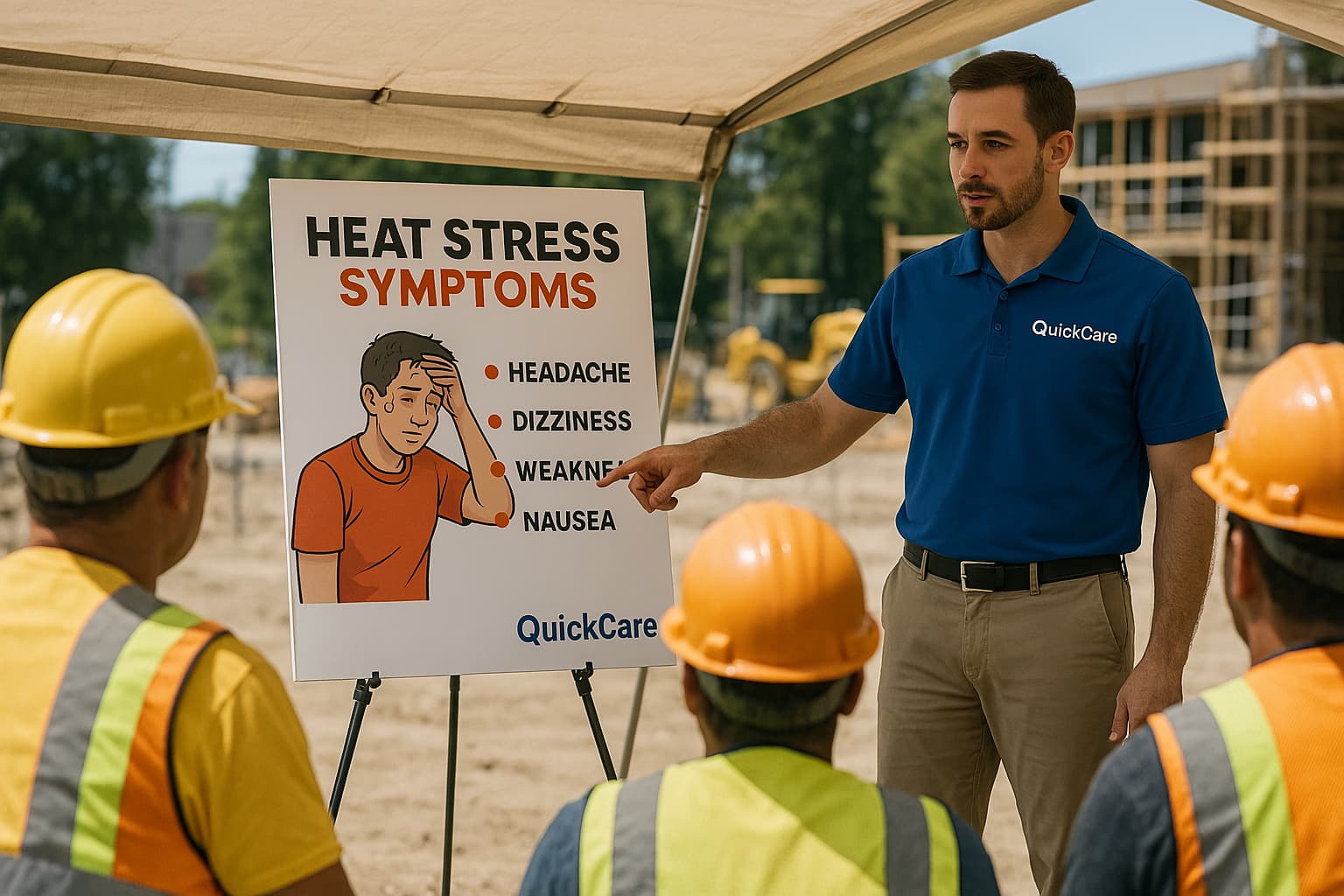
Reduce heat risk, improve response consistency, and protect productivity during hot weather—without relying on guesswork when symptoms appear.
Demonstrate training, procedures, and real implementation through documented response actions and follow-up.
Early assessment and cooling support helps keep minor symptoms from becoming major incidents.
Clear escalation criteria and on-site evaluation helps reduce unnecessary ER trips while prioritizing safety.
Faster, more consistent response keeps supervisors focused and reduces disruption during high-heat periods.
Workers are more likely to report symptoms early when they know the response process is reliable and respectful.
Consistent records support safety review, corrective actions, and leadership visibility across sites and supervisors.
These controls work best when they’re written as simple expectations supervisors can enforce and workers can follow—even during busy shifts.
Ramp up new/returning workers over several days. Early-season heat events are when programs fail first.
Shift heavy tasks to cooler hours when possible and rotate roles to reduce sustained heat load.
Pair workers and require check-ins. People often underreport their own symptoms until it’s serious.
Airflow, shade structures, reflective barriers, and cooling zones reduce risk more reliably than reminders alone.
Make it obvious when to stop work, call QuickCare, and call 911—then train it until it’s automatic.
Track forecasts and heat index trends; adjust staffing and work/rest patterns before symptoms appear.
Common questions about heat illness prevention programs, response expectations, and how QuickCare supports your on-site operations.
Response time varies by location, traffic, and coverage in your area. We dispatch the nearest available responder when you call. For high-risk operations (peak summer heat, multiple crews, or remote sites), ask about dedicated on-site staffing options. See the service map for coverage.
No. Employers still maintain the full program (water, shade/cooling, rest, acclimatization, and supervision). QuickCare strengthens the training and emergency response portions: assessment, documentation, and coordination when a worker isn’t improving.
Our responder can assess the worker, monitor vitals as appropriate, support cooling measures and basic first-aid interventions, and document findings and actions. When symptoms indicate higher risk, we help coordinate escalation and EMS. If heat stroke is suspected, call 911 immediately.
Many heat events worsen because symptoms are reported late or handled inconsistently. Earlier reporting, clearer escalation criteria, and on-site assessment can reduce unnecessary escalation while ensuring serious cases are treated urgently. Outcomes always depend on severity, timing, and job conditions.
We offer on-site training and virtual options. Programs can be delivered as supervisor-only, worker-only, or combined sessions. Completion documentation is provided to support your compliance and internal training records. For broader workplace readiness, see ProTrain.
Heat response often overlaps with broader injury and safety operations. Many clients pair this with First-Aid Response, CPR/AED Training, and other on-site programs to strengthen readiness across incidents.
Build a heat illness prevention program your supervisors can execute—then back it up with on-site response and documentation when symptoms occur.