QuickCare Solutions
Construction Safety

Comprehensive Safety Solutions for Construction Sites

Support your crews with on-site First-Aid Response (24/7 dispatch line), drug and alcohol testing, respirator fit testing, and CPR/AED training—built for the realities of the job site.

33%

of construction fatalities are caused by falls

75%

of struck-by fatalities involve heavy equipment

Fatal Four

OSHA's focus areas for construction safety

Source: OSHA construction industry safety data. See Service Map for coverage details.

Understanding Construction Site Hazards

Identify the highest-frequency risks, then build response and prevention into daily operations.

The construction industry presents numerous inherent safety challenges that contribute significantly to workplace injuries and fatalities. Understanding these hazards is crucial for implementing effective safety protocols and compliance measures.

Construction Site Safety Challenges

The "Fatal Four" hazards and how QuickCare services support response and compliance.

Falls

Falls account for over one-third of job site fatalities. Working at heights, on slippery surfaces, or unstable terrain significantly increases risk.

33% of construction fatalities

  • On-site First-Aid Response
  • Drug & Alcohol Testing
  • CPR/AED & First-Aid Training
Fatal Four

Struck-By Accidents

Involving moving vehicles, machinery, and falling objects. Heavy equipment like trucks and cranes are implicated in 75% of fatal cases.

14K+ injuries annually

  • Mobile Drug & Alcohol Testing
  • On-site First-Aid Response
Fatal Four

Caught-In/Between

Entanglement in machinery, entrapment in trenches, or crushing injuries in confined spaces, presenting significant risks of severe injury.

  • First-Aid Response with 24/7 dispatch
  • Pre-Employment Drug & Alcohol Testing
  • First-Aid Training
Fatal Four

Electrocution

A leading cause of construction fatalities. Working with power tools, electrical equipment, and site wiring creates numerous hazards.

  • On-site First-Aid Response
  • Random Drug Testing
  • CPR/First-Aid Training
Fatal Four
OSHA Fatal Four construction hazards chart showing percentages of deaths caused by falls, struck-by objects, electrocutions, and caught in/between incidents

OSHA's "Fatal Four"

OSHA has identified falls, struck-by incidents, caught-in/between accidents, and electrocution as the four most critical job site hazards, often referred to as the "Fatal Four" or "Big Four."

Regulatory Landscape and Compliance

Support your programs and program records with practical on-site workflows.

OSHA plays a central role in establishing and enforcing safety standards within the construction industry. Compliance with these regulations is not only a legal requirement but essential for creating a safe working environment.

First Aid Requirements

  • Medical personnel must be available for consultation
  • Provisions for prompt medical attention in case of serious injury
  • If medical facilities aren't reasonably accessible, a person with valid first-aid training must be present
  • OSHA interprets "reasonably accessible" as having emergency services available within 3-4 minutes
  • First-aid supplies must be easily accessible and maintained in weatherproof containers
QuickCare Solution: Our on-site First-Aid Response (24/7 dispatch line) can support your jobsite first-aid program, with visit documentation for your records. It is non-emergency, first-aid-level care and not a replacement for 911. Arrival time depends on location, clinician availability, traffic, and current conditions.

Drug & Alcohol Testing

  • Effective testing programs are crucial given high rates of substance abuse in construction
  • DOT compliance mandatory for certain safety-sensitive roles
  • Testing helps maintain a drug-free workplace
  • Reduces risk of accidents caused by impairment
QuickCare Solution: Our Mobile Drug & Alcohol Testing covers DOT (following 49 CFR Part 40 procedures) and non-DOT programs, with chain-of-custody documentation to support your testing program and records.

Respiratory Protection

  • The employer owns the respiratory protection program. For construction work, 29 CFR 1926.103 applies the requirements of 29 CFR 1910.134; in California, Cal/OSHA 8 CCR 5144 applies
  • The employer's own hazard evaluation decides whether respirators are needed and which type, and the employer must have a written program (29 CFR 1910.134(c) and (d))
  • The employer must provide a respirator medical evaluation, made by a licensed healthcare professional, before fit testing or required use (29 CFR 1910.134(e))
  • The employer must fit test employees who wear tight-fitting respirators before first use, whenever a different facepiece is used, and at least annually, and again after physical changes that could affect fit (29 CFR 1910.134(f))
  • The employer must train employees before required respirator use, with retraining at least annually (29 CFR 1910.134(k))
  • Silica, asbestos, lead, welding fume and chemical vapors may need specific cartridges, supplied air, air monitoring or engineering controls. A fit test does not answer those hazards
QuickCare Solution: Our in-person Respirator Package supports the medical evaluation, fit testing and training elements of your respiratory protection program for employees who wear tight-fitting respirators. It is available only in the greater San Francisco Bay Area. QuickCare does not select respirators or monitor air; your hazard evaluation decides that.

Related guide: fit testing for construction crews

Wherever respirators are necessary to protect workers' health or are required by the employer, the employer must have a written respiratory protection program with worksite-specific procedures, based on its own evaluation of the hazards. Written Respiratory Protection Program

Guide: written respiratory protection programs for construction employers

QuickCare Solutions: Your Partner in Construction Safety

On-site services for construction crews across the greater San Francisco Bay Area, with a 24/7 dispatch line for first-aid response.

QuickCare Solutions brings on-site first-aid response, drug and alcohol testing, respirator fit testing, and CPR/AED training to construction companies across the greater San Francisco Bay Area, to support your safety program and its records. First-aid response has a 24/7 dispatch line; testing, fit testing, and training are scheduled around your crews.

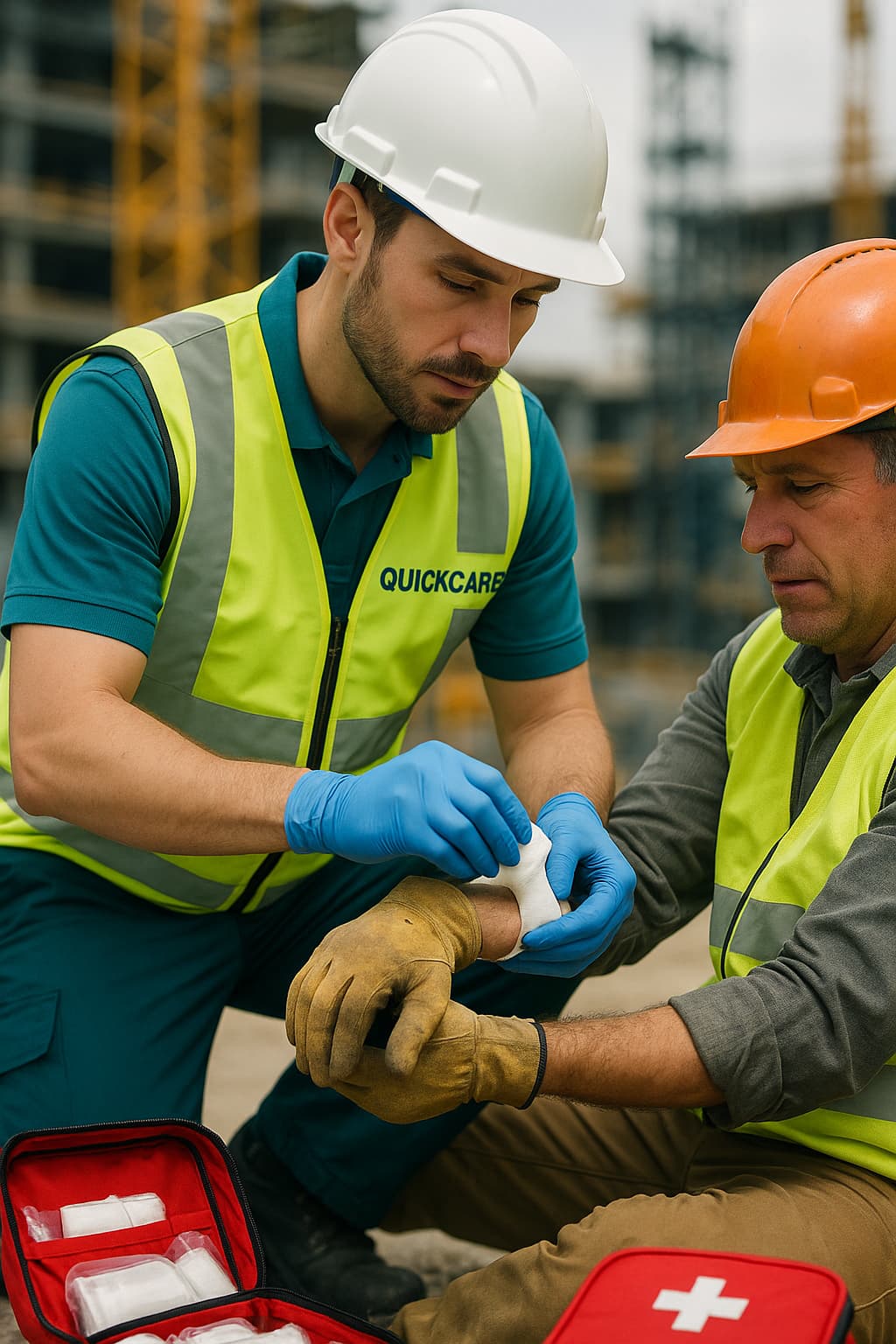
First-Aid Response at Construction Site
Most Popular

First-Aid Response

$525 per visit*

A licensed clinician comes to your jobsite to provide first-aid-level care for non-emergency workplace injuries, with a 24/7 dispatch line. For life-threatening emergencies, call 911.

  • Arrival time varies by site location and availability
  • Trained medical professionals
  • First-aid-level treatment
  • Medical supplies included
  • Detailed documentation

*Does not include TDaP vaccine(s), if ordered.

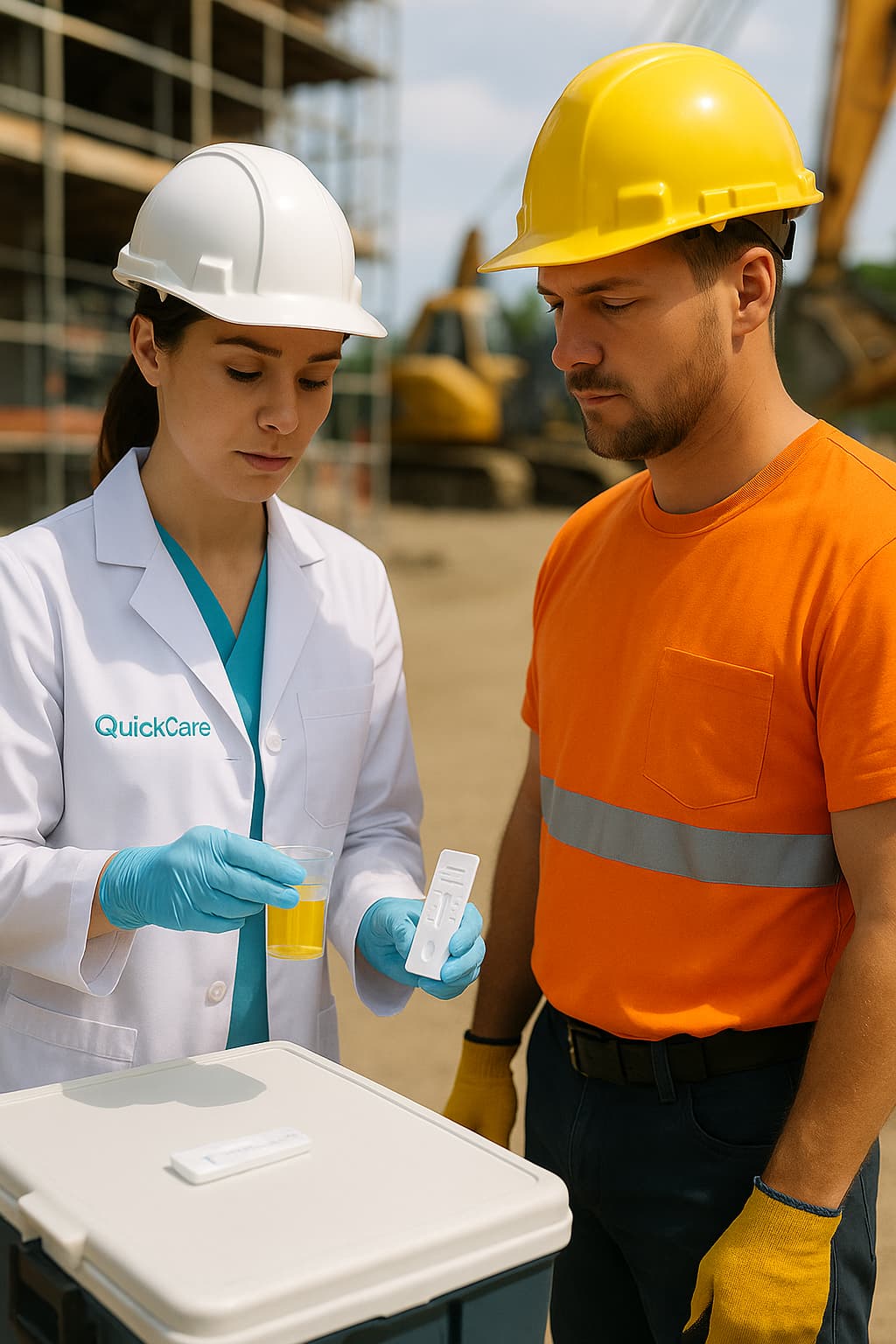
Photorealistic portrait of a female QuickCare medical professional wearing a white lab coat with “QuickCare” logo and blue gloves, calmly conducting a drug or alcohol test at a construction site. She holds a test cup with yellow liquid in one hand and a rapid test device in the other. A male construction worker in an orange high-visibility shirt and yellow hard hat observes attentively. The background shows scaffolding and construction equipment slightly blurred under bright daylight, emphasizing a clean, professional testing environment.

Drug & Alcohol Testing

Starting at $64 per test

Drug and alcohol testing collected at your jobsite. We provide point-of-care testing (POCT) and laboratory testing for DOT (following 49 CFR Part 40 procedures) and non-DOT programs.

  • Pre-employment drug & alcohol testing
  • Random testing
  • Reasonable suspicion testing
  • Post-incident testing
  • After-hours and weekend dispatch for urgent testing
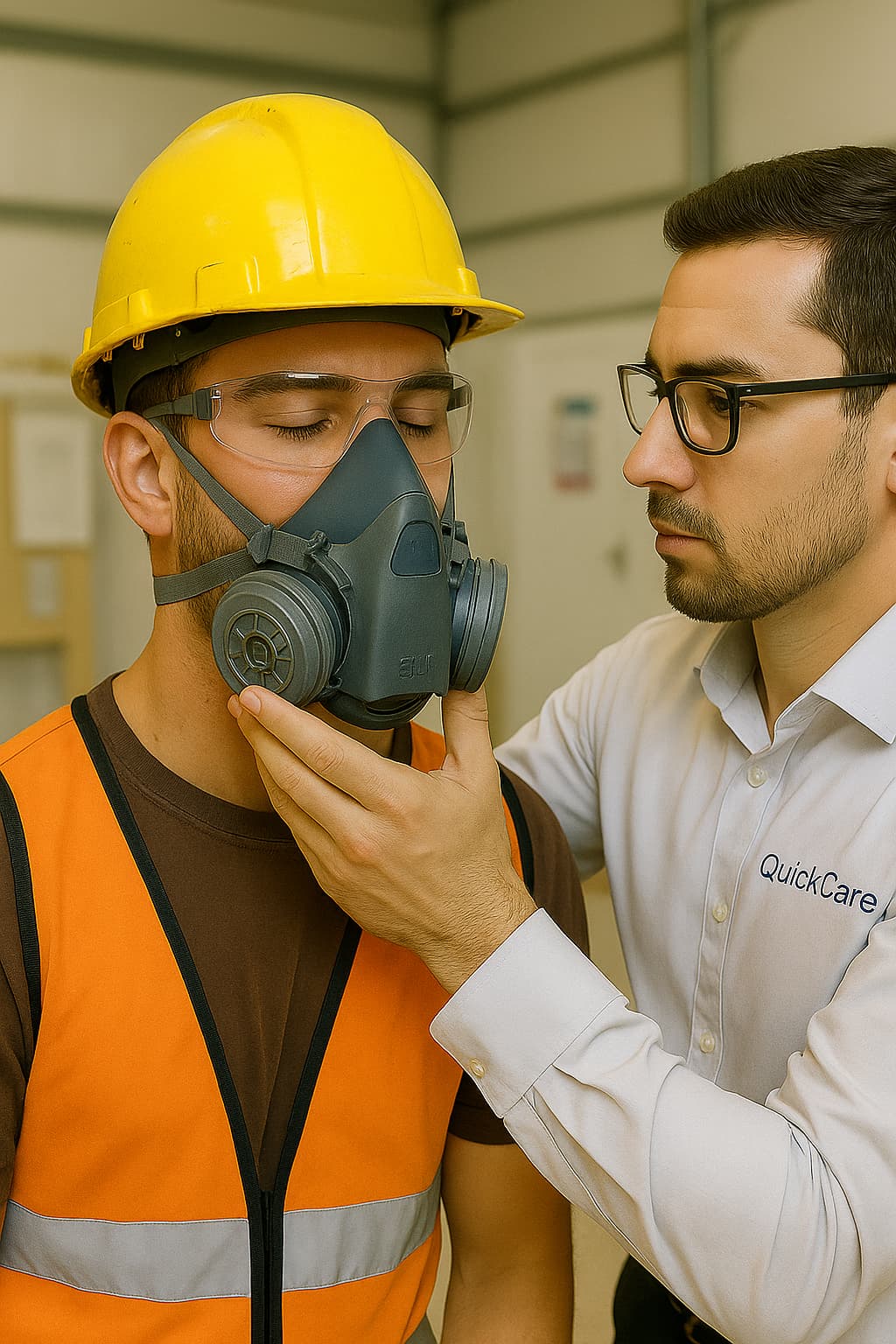
Respirator Fit Testing at Construction Site

Respirator Package

$149.00 per employee

An in-person package that supports the respiratory protection program of employers whose crews wear tight-fitting respirators. The employer's hazard evaluation decides whether respirators are needed and which type; QuickCare does not select respirators or monitor air.

  • Respirator medical evaluation and clearance process
  • Blood pressure assessment
  • Pulmonary function testing (PFT)
  • Physical respirator fit testing
  • Respirator training

Available throughout the greater San Francisco Bay Area. QuickCare comes to your workplace or jobsite, so employees do not travel to a clinic. Other configurations, such as additional respirator models per employee or multi-shift and multi-site programs, are quoted by scope. Medical clearance is determined by the reviewing clinician. Buying the package does not guarantee medical approval.

Need an online-only option? ProTrain by QuickCare is a separate virtual service, available in all 50 states, with its own pricing. It provides online respirator medical evaluations and clearance, online respirator training and respiratory records management. It does not include blood pressure measurement, pulmonary function testing or physical fit testing, and an online evaluation is not a fit test. Learn about ProTrain or ask about ProTrain for your team.

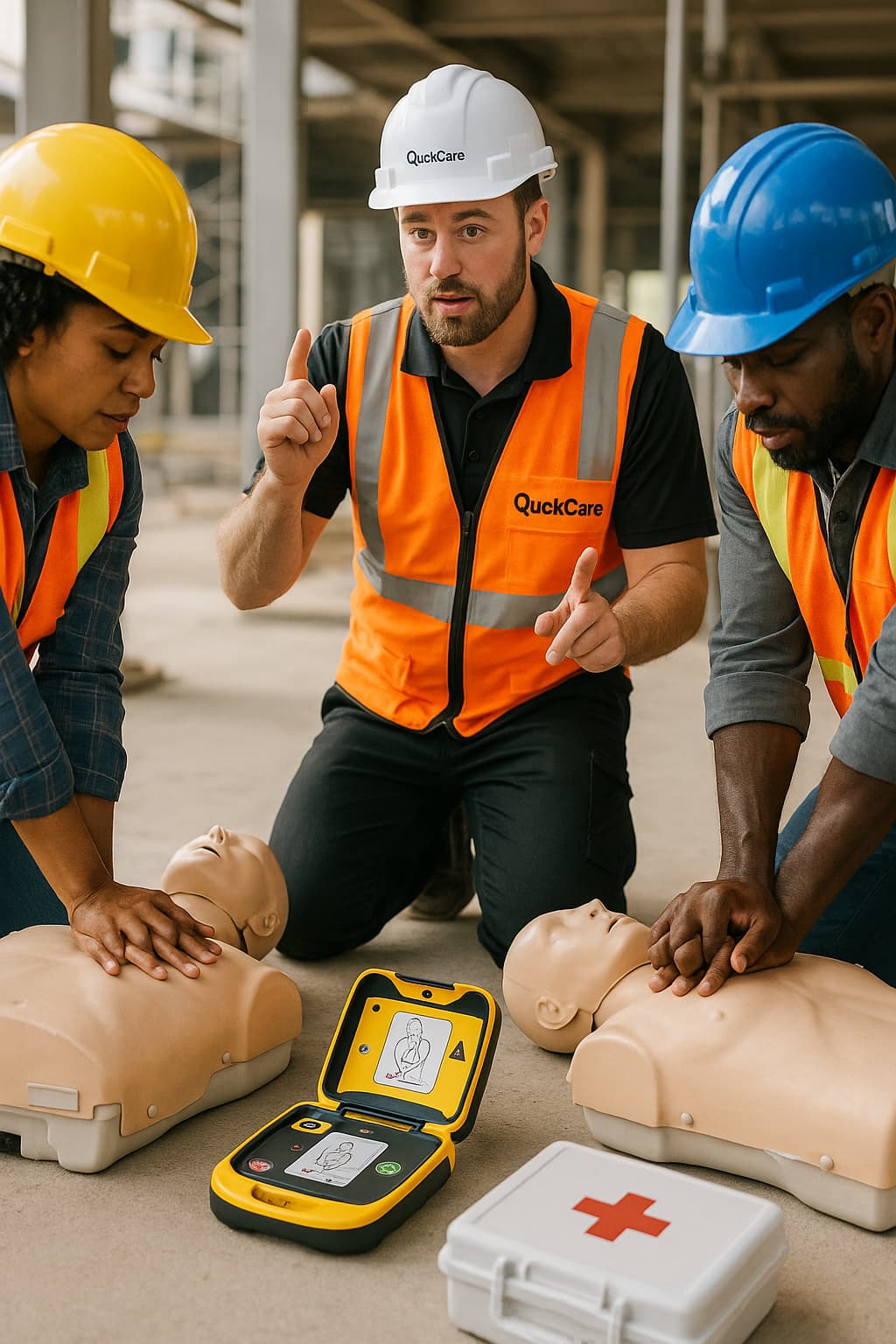
CPR Training at Construction Site

CPR/AED & First-Aid Classes

Starting at $675 per group

Group CPR, AED, and first-aid training for your crews, delivered at your workplace.

  • Hands-on CPR practice
  • AED usage training
  • First-aid techniques
  • Certification upon completion
  • On-site training available

Frequently Asked Questions

Common questions from construction safety and operations teams.

How does on-site First-Aid Response support injury response on a construction site?

A licensed clinician comes to your jobsite to assess the injury and provide OSHA first-aid-level care for non-emergency workplace injuries. Every visit comes with documentation of the assessment, treatment, aftercare instructions, and return-to-work status for your records. Call 911 for life-threatening emergencies. QuickCare does not guarantee how an incident is classified or any claim, regulatory, or inspection outcome.

What types of drug and alcohol testing do you offer for construction sites?

QuickCare offers drug and alcohol testing for construction crews, collected at your jobsite, including:

  • Point of Care Testing (POCT) - On-site screening, with non-negative results sent for laboratory confirmation
  • DOT testing - Follows 49 CFR Part 40 procedures, with DOT-qualified collectors
  • Laboratory-based testing - With Medical Review Officer (MRO) review
  • Testing types - Pre-employment, random, post-accident, and reasonable suspicion
  • Testing methods - Urine, oral fluid, hair, and breath alcohol testing

Testing is collected directly at your construction site with chain-of-custody documentation, and QuickCare offers after-hours and weekend dispatch for urgent post-accident or reasonable-suspicion testing.

How often should construction workers undergo respirator fit testing?

The employer must make sure employees who wear tight-fitting respirators are fit tested (29 CFR 1910.134(f), which applies to construction work through 29 CFR 1926.103; in California, Cal/OSHA 8 CCR 5144):

  • Initially - Before first use of the respirator
  • Different facepiece - Whenever a different respirator facepiece (size, style, model or make) is used
  • Annually - At least annually thereafter
  • When changes occur - Again when physical changes that could affect respirator fit are reported or observed (such as facial scarring, dental changes, cosmetic surgery, or an obvious change in body weight)

Fit testing follows a respirator medical evaluation made by a licensed healthcare professional, and it belongs inside the employer's written respiratory protection program. It does not apply to loose-fitting hoods or helmets, or to voluntary use of filtering facepiece respirators. A fit test does not tell the employer which respirator suits a hazard; the employer's hazard evaluation decides that, and QuickCare does not select respirators or monitor air.

QuickCare's in-person Respirator Package supports the medical evaluation, fit testing and training elements of your program for crews who wear tight-fitting respirators. It is available only in the greater San Francisco Bay Area; for an online-only option, see the Respirator Package card above.

What affects the arrival time of QuickCare's on-site First-Aid services?

Arrival time for QuickCare's on-site First-Aid services to construction sites depends on factors such as:

  • Geographic location within our service area
  • Clinician availability
  • Traffic conditions
  • Weather and other current conditions

Arrival time is not guaranteed. For life-threatening emergencies, call 911. For construction sites with recurring needs, ask us about scheduling options.

How do your services help with OSHA compliance on construction sites?

QuickCare's services can support your OSHA program on construction sites in several ways:

  • First-Aid Response - Supports your jobsite first-aid program (29 CFR 1926.50), especially when medical facilities are not "reasonably accessible"; arrival time depends on location, clinician availability, traffic, and current conditions
  • Respirator Package - Supports the medical evaluation, fit testing and training elements of the employer's respiratory protection program (29 CFR 1910.134, applied to construction through 29 CFR 1926.103; Cal/OSHA 8 CCR 5144 in California) for crews who wear tight-fitting respirators. In-person service is available only in the greater San Francisco Bay Area, and the employer's hazard evaluation decides who needs a respirator and which type
  • Drug & Alcohol Testing - Supports compliance with DOT regulations for safety-sensitive positions and helps maintain a safe workplace
  • CPR/AED & First-Aid Training - Certification on completion, to support your program for trained first-aid personnel on site
  • Documentation - First-aid visit documentation, chain-of-custody records for testing, and training certification, for your files

QuickCare does not guarantee regulatory or inspection outcomes. These services support, and do not replace, your own safety program.

Elevate Your Construction Site Safety

Partner with QuickCare Solutions for on-site first-aid response, drug and alcohol testing, respirator fit testing, and CPR/AED training for construction crews across the greater San Francisco Bay Area.