8
Hours — Alcohol Testing
Post-accident breath alcohol test must be administered within 8 hours of the accident.

Mobile, on-site DOT drug testing for FMCSA-regulated motor carriers. Keep your fleet compliant and your drivers on the road with our certified collection services throughout the Bay Area and Middle Georgia.
The Department of Transportation (DOT) mandates drug and alcohol testing for all employees performing safety-sensitive functions in transportation industries. Under 49 CFR Part 40 and 49 CFR Part 382, motor carriers must implement comprehensive testing programs to ensure public safety on our roadways.
Non-compliance with DOT drug testing regulations can result in civil penalties — as of 2026, up to $19,246 per violation for the regulated entity (49 CFR Part 386, Appendix B, adjusted annually for inflation — confirm the current schedule with FMCSA) — plus driver disqualification and loss of operating authority. QuickCare's mobile testing services help you maintain full compliance while minimizing operational disruption.
FMCSA Clearinghouse Requirement: Since January 2020, all DOT drug and alcohol violations must be reported to the FMCSA Drug & Alcohol Clearinghouse. Employers must query the Clearinghouse before hiring and conduct annual queries for current drivers. QuickCare handles all required Clearinghouse reporting for our clients.
Our testing protocols strictly adhere to all DOT collection procedures, chain of custody requirements, and MRO review processes as mandated by federal regulations.
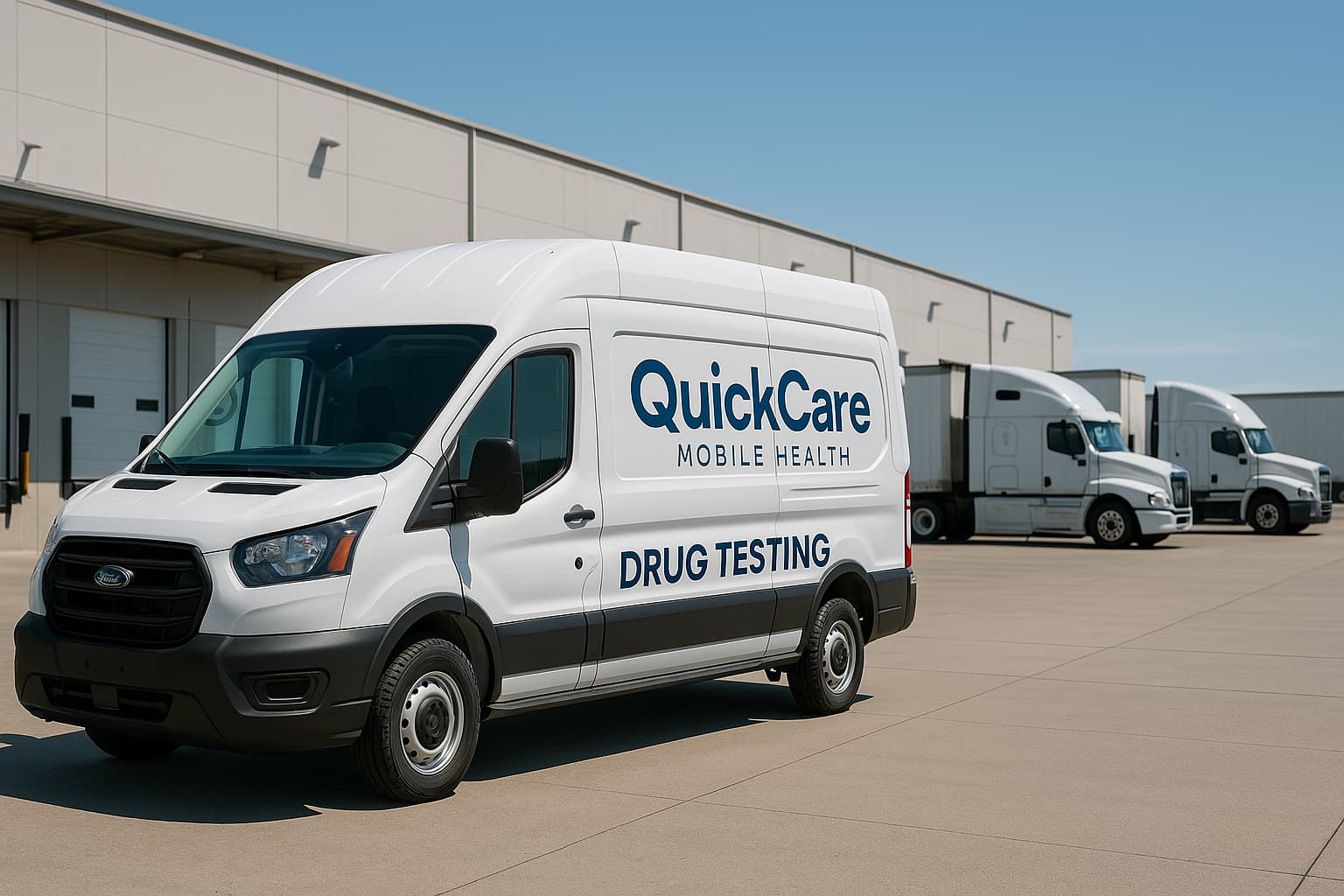
Our DOT-qualified collectors come to your terminal, maintenance facility, or job site, reducing driver downtime compared to off-site clinic visits.
We maintain all required records per DOT retention requirements: 5 years for positive tests and refusals, 1 year for negative tests, and annual MIS reports ready for FMCSA audits.
 verified 49 CFR Part 40
DOT regulations specify strict timeframes for post-accident testing. Missing these deadlines can result in violations and complicate insurance claims.
8
Post-accident breath alcohol test must be administered within 8 hours of the accident.
32
Post-accident urine drug test specimen must be collected within 32 hours.
2
Employees must proceed to the collection site within 2 hours of random selection notification.
24
Collected specimens must be shipped to the laboratory within 24 hours of collection.
DOT regulations under 49 CFR Part 40 establish standardized procedures for drug and alcohol testing across all DOT-regulated transportation modes.
DOT mandates specific testing scenarios throughout the employment lifecycle. Each category has distinct triggers, procedures, and documentation requirements.
FMCSA regulations (49 CFR Part 382) define safety-sensitive functions for commercial motor vehicle operators.
The DOT-mandated drug panel tests for five specific categories of controlled substances as required by SAMHSA guidelines.
Each testing category has specific triggers, procedures, and compliance requirements. Understanding when testing is required helps prevent violations.
| Test Type | When Required | Key Requirements | Timeline |
|---|---|---|---|
| Pre-Employment Mandatory |
Before an employee first performs safety-sensitive functions for any employer | Must receive verified negative result before allowing safety-sensitive work. Must also query FMCSA Clearinghouse. | Result valid for 90 days if no subsequent employer; must be hired within 90 days of collection |
| Random Testing Mandatory |
Unannounced selections throughout the calendar year using scientifically valid random method | 50% of driver pool for drugs, 10% for alcohol annually. Each driver must have equal selection probability. | Driver must proceed to collection site immediately upon notification (within 2 hours) |
| Post-Accident Time-Critical |
After accidents involving: • Fatality (always required) • Bodily injury requiring medical transport AND driver received citation • Disabling vehicle damage AND driver received citation |
Test regardless of fault in fatality accidents. Document if testing cannot be completed within required timeframes. |
Alcohol: Within 8 hours Drugs: Within 32 hours Do not administer after these windows. |
| Reasonable Suspicion | Based on specific, contemporaneous, articulable observations of appearance, behavior, speech, or body odors | Supervisor making determination must have completed DOT-approved reasonable suspicion training. Documentation required. | Test as soon as possible. Alcohol test must be within 8 hours of observation or document why not. |
| Return-to-Duty | After any DOT drug/alcohol violation, before resuming safety-sensitive functions | Must complete SAP evaluation, follow treatment recommendations, and receive verified negative result under direct observation. | No minimum waiting period, but all SAP requirements must be completed first |
| Follow-Up | After returning to duty following a violation, as scheduled by the SAP | Minimum 6 unannounced tests in first 12 months. SAP can extend up to 60 months total. Direct observation required. | As scheduled by SAP; unannounced and unpredictable |
Non-compliance with DOT drug and alcohol testing regulations carries significant civil and operational penalties for both carriers and drivers. Civil penalty maximums below are adjusted annually for inflation under 49 CFR Part 386, Appendix B — figures shown are current as of 2026; always confirm the current schedule with FMCSA.
| Penalty | Category | What It Covers |
|---|---|---|
| Up to $19,246 | Per Violation – Regulated Entity | Maximum civil penalty for each instance of failing to implement required testing, falsifying records, or allowing untested drivers to operate. |
| Up to $4,812 | Per Violation – Individual Driver | Maximum civil penalty an individual driver can face for a testing-program violation under 49 CFR Part 382. |
| Disqualification | Driver Consequences | Drivers who test positive, refuse to test, or have violations reported to the Clearinghouse are prohibited from safety-sensitive functions until completing the return-to-duty process. |
| Loss of Authority | Operational Impact | Severe or repeated violations can result in suspension or revocation of operating authority, effectively shutting down carrier operations. |
Our mobile DOT drug testing services are designed specifically for the operational realities of the transportation industry.
On-site testing eliminates travel to clinics and waiting room delays. Your drivers spend minutes, not hours, completing required tests—keeping trucks moving and revenue flowing.
Accidents don't follow business hours. Our collectors are available around the clock to meet DOT's strict post-accident testing deadlines—8 hours for alcohol, 32 hours for drugs.
Our collectors are trained in DOT-specific procedures under 49 CFR Part 40. Every specimen is documented, sealed, and transported using a process designed to meet chain-of-custody standards.
We handle required FMCSA Clearinghouse reporting for all violations. Pre-employment queries, annual queries, and violation reporting—fully managed so you stay compliant.
Complete documentation maintained per DOT retention requirements. When FMCSA conducts a compliance review, your records will be organized, complete, and readily accessible.
Small fleets can join our consortium for cost-effective random testing pool management. We handle selection, scheduling, and compliance documentation so you can focus on operations.
 local_shipping We Come To You
Traditional DOT testing forces drivers to leave your facility, travel to a clinic, wait for their turn, and travel back—often consuming 2-4 hours of productive time per test. Our mobile collection service eliminates this operational drain.
Our fully-equipped mobile collection units arrive at your location with everything needed for DOT-compliant testing: DOT-qualified collectors trained in 49 CFR Part 40 procedures, proper custody and control forms (CCFs), DOT-approved Evidential Breath Testing devices, and secure specimen transport supplies.
We coordinate testing around your operational schedule—early morning before dispatch, during driver breaks, or at shift changes—minimizing disruption while ensuring you meet all DOT random testing rate requirements.
On-Site
Testing at your terminal, yard, or job site — no clinic visit
49 CFR Part 40
Every collection follows DOT chain-of-custody procedures
24/7
Emergency post-accident response availability
Every step follows strict 49 CFR Part 40 protocols to ensure specimen integrity, legal defensibility, and full regulatory compliance.
We review your operation's specific needs: fleet size, driver count, operational schedule, and existing policies. We'll ensure your written drug and alcohol policy meets DOT requirements and establish you as a registered employer in the FMCSA Clearinghouse.
Using a scientifically valid random selection method, we manage your testing pool to ensure you meet DOT's 50% annual drug testing rate and 10% alcohol rate. Selections are spread throughout the year with unpredictable timing to maintain the deterrent effect.
Our DOT-qualified collectors arrive at your facility with all required supplies. We verify driver identity using photo ID, complete the Federal Drug Testing Custody and Control Form (CCF), collect the split-specimen urine sample, and conduct breath alcohol testing using NHTSA-approved EBT devices when required.
Specimens are shipped within 24 hours to a SAMHSA-certified laboratory. Initial immunoassay screening identifies presumptive positives, which undergo confirmation testing using gas chromatography-mass spectrometry (GC/MS) for definitive results.
All non-negative results are reviewed by a licensed physician qualified as a Medical Review Officer. The MRO contacts the donor to discuss any legitimate medical explanations (such as valid prescriptions) before making a final determination. This critical step prevents false positives from valid medications.
Results are reported to your Designated Employer Representative (DER) through our secure portal. For any violations, we handle required FMCSA Clearinghouse reporting and provide guidance on next steps including SAP referrals. All documentation is maintained per DOT retention requirements.
QuickCare provides mobile DOT drug testing services throughout the San Francisco Bay Area and Middle Georgia region.
Comprehensive mobile DOT testing coverage across all nine Bay Area counties. Same-day response available for post-accident testing. Ideal for trucking terminals, distribution centers, and transportation companies along major freight corridors including I-80, I-880, and I-580.
Mobile DOT testing services covering the Macon metropolitan area and surrounding counties. Strategic coverage along I-75 and I-16 corridors serving trucking operations, logistics companies, and distribution facilities throughout central Georgia.
Transparent, competitive pricing for DOT-compliant drug and alcohol testing services. Volume discounts available for fleets with 10+ drivers.
Complete urine drug screen with MRO review
$89.00per test
Evidential Breath Testing (EBT) for alcohol
$64.00per test
Complete C/TPA consortium management
Custompricing
Common questions about DOT drug and alcohol testing requirements, procedures, and our mobile testing services.
DOT drug testing follows strict federal guidelines under 49 CFR Part 40 that differ significantly from standard workplace drug testing:
Non-DOT testing allows employers more flexibility in panel selection, collection methods, and result handling. However, DOT-regulated employers must maintain completely separate testing programs—DOT and non-DOT tests cannot be combined or substituted.
FMCSA requires motor carriers to randomly test their safety-sensitive employees at specific annual rates. As of 2026, the minimum rates are:
FMCSA reviews these rates each year based on industry-wide positive test data and can raise or lower them — always confirm the current rate with FMCSA before setting your testing pool. Additional compliance requirements:
QuickCare's consortium services handle all aspects of random selection and scheduling, ensuring you meet these requirements without administrative burden.
A verified positive DOT drug test triggers a mandatory sequence of events:
Note: Employers are not required to hold the driver's position during this process, though some choose to do so. The entire return-to-duty process is at the driver's expense unless the employer's policy states otherwise.
DOT post-accident testing is required in specific circumstances—not every accident triggers testing requirements:
Testing is ALWAYS required if:
Testing is required if the driver received a citation AND:
Critical Timing Requirements:
If testing cannot be completed within these windows, you must document the reasons and cease attempts. The driver should not consume alcohol for 8 hours following the accident or until tested.
QuickCare offers 24/7 emergency response for post-accident testing throughout our service areas to help you meet these strict deadlines.
The DOT 5-panel drug test screens for the following substance categories:
Alcohol Testing: Conducted separately using Evidential Breath Testing (EBT) devices. Results of 0.02-0.039 BAC require removal from safety-sensitive duties for 24 hours. Results of 0.04 BAC or higher constitute a DOT violation.
Important: Employers cannot add substances to the DOT panel or change cutoff levels. Additional non-DOT testing must be conducted as a completely separate test.
Yes, QuickCare provides 24/7 emergency response for post-accident and reasonable suspicion testing throughout our California Bay Area and Middle Georgia service regions.
Our emergency response capabilities include:
For established clients, we recommend programming our emergency line into your accident response protocols and training dispatchers on when DOT post-accident testing is required. This preparation ensures you can initiate testing immediately when an accident occurs.
The FMCSA Drug & Alcohol Clearinghouse is a secure federal database that tracks drug and alcohol violations for commercial driver's license (CDL) holders. Operating since January 2020, it serves as a central repository for violation information.
Employer Requirements:
Query Types:
QuickCare handles Clearinghouse reporting for all violations identified through our testing services and can assist with query management as part of our consortium services.
Complete your workplace safety and compliance program with these additional QuickCare services.
Comprehensive workplace drug testing programs for non-regulated employees. Flexible panels, rapid and lab-based options, and customizable policies.
Learn More arrow_forwardComplete drug-free workplace program development including policy creation, supervisor training, employee education, and testing protocols.
Learn More arrow_forwardOSHA-compliant quantitative and qualitative fit testing for N95, half-mask, and full-face respirators. On-site mobile testing available.
Learn More arrow_forwardComprehensive safety programs designed for trucking companies, logistics providers, and fleet operators—beyond just drug testing.
Learn More arrow_forwardPartner with QuickCare for mobile DOT drug testing that keeps your drivers on the road and your company in full federal compliance. Schedule a consultation to discuss your fleet's needs.