Clinic-Based vs. On-Site Fit Testing: Which Is Better for Employers?
Send people to a clinic, or bring testing to your site? The right call depends on your headcount, shifts, and how much downtime you can absorb.
The short version
- Clinic-based testing sends employees out; on-site testing brings the tester in.
- On-site testing usually wins on downtime, travel, scheduling control, and multi-shift teams.
- Clinic-based can still make sense for a single employee or a one-off new hire.
- For most groups, a single on-site day is the more practical choice.
Who this is for: Employers and EHS leaders deciding how to deliver respirator fit testing to a team.
There are two ways to get a crew fit tested: send each employee to a clinic, or have a tester come to your site. Both produce a valid fit test — the difference is in the operational cost around it: hours lost, appointments juggled, and how consistent the paperwork comes back.
This guide compares the two honestly, including when clinic-based testing is still the better call, so you can match the approach to your team rather than to a sales pitch.
Clinic-based vs. on-site, head to head
| Factor | Clinic-based | On-site (mobile) |
|---|---|---|
| Employee downtime | Each person leaves to travel, wait, and test | Employees step away briefly, then back to work |
| Travel time | Multiplied across every employee | The tester travels once, to you |
| Scheduling control | Tied to clinic availability and individual bookings | You set the day and sequence the crew |
| Multi-shift teams | Hard to align across shifts | Test each shift in place, in blocks |
| Documentation consistency | Records can arrive piecemeal from many visits | One visit, one consistent set of records |
| Small teams | Can be efficient for one or two people | Still works, but a clinic may be simpler for a single person |
| Larger groups | Downtime and coordination scale up fast | Scales well — a full crew in one block |
Weighing on-site against clinic visits?
Tell QuickCare your headcount, shifts, and location and we will help you compare a single on-site day against sending everyone to a clinic.
When clinic-based testing may still make sense
On-site is not automatically the answer. Clinic-based testing can be the simpler, more economical choice when:
- You need to test a single new hire or one-off employee, not a group.
- An employee missed the on-site day and needs a catch-up test.
- There is a clinic already next door and pulling one person away is trivial.
For a single person with a nearby clinic, the coordination overhead of an on-site visit may not pay off.
When on-site testing is more practical
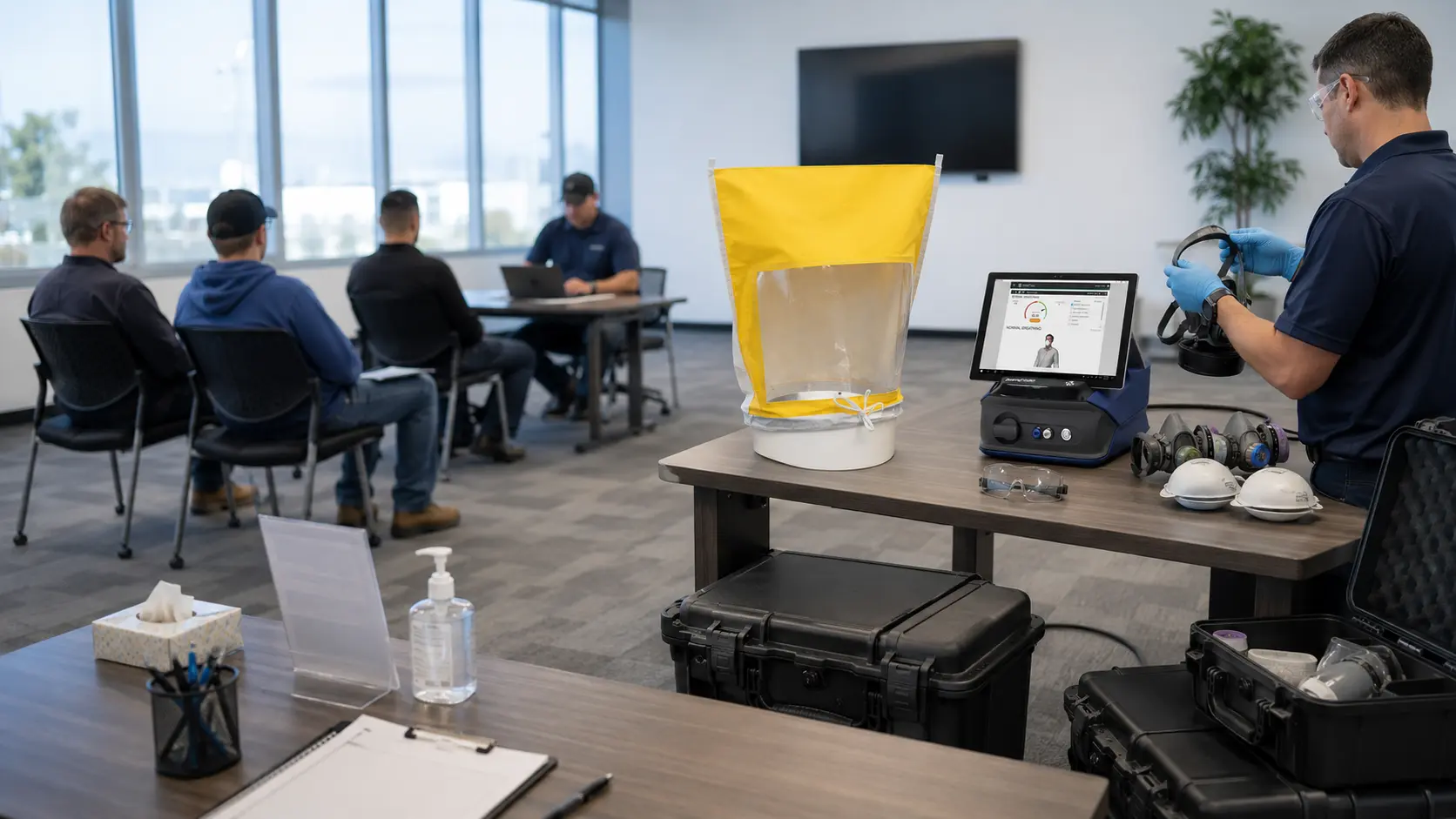
Once you are testing a group — especially across shifts — the math tilts toward on-site. Instead of every employee losing a half-day to travel and waiting, the tester comes to you and works through the crew in blocks while people stay close to their work.
- You keep downtime to a few minutes per person instead of hours.
- You control the schedule and group people by shift, crew, or respirator type.
- Medical clearance is coordinated online by SMS — before the visit or on the day — so the on-site day is not gated by separate clinic clearance trips.
- You get one consistent set of records from a single visit, which is far easier to file.
That is the model behind our on-site respirator fit testing for employers across California and the Bay Area — including teams in South San Francisco, Oakland, and Napa. To see how a single day comes together, start with how to plan an on-site fit testing day.
Frequently asked questions
Is on-site fit testing as valid as clinic-based?
How many employees make on-site worth it?
Can on-site testing handle multiple shifts in one day?
Which option gives more consistent documentation?
Weighing on-site for your team?
Tell us your headcount, shifts, and location and we will help you compare a single on-site day against clinic visits.
Compare on-site for your team arrow_forward