Annual Respirator Fit Testing Checklist for Employers
Fit testing is rarely one-and-done. Run this checklist each cycle so the annual round is a planned event, not a scramble.
The short version
- Treat fit testing as a recurring program, not a one-time project.
- Each cycle: confirm who needs testing, the respirator models, and clearance status.
- Schedule by department, shift, or crew, and prepare the testing space.
- Communicate expectations, plan for retests, and store the records after the visit.
Who this is for: EHS managers and HR coordinators running a recurring respiratory-protection program.
For most employers, respirator fit testing comes back around on a cycle. The teams that handle it smoothly treat the annual round like any other scheduled program: a known list of people, a booked day, and a place to file the results.
Use the steps below as your recurring checklist. Run it the same way each cycle and the annual round becomes routine instead of a last-minute push.
Your annual fit testing checklist
Work top to bottom. The first three steps are where the planning pays off.
-
Confirm who needs testing
Pull a current list of everyone in a respirator role, including new hires since the last round and anyone who changed jobs. Remove people who no longer wear a respirator.
-
Confirm respirator models
Verify the make, model, and size each person is assigned. Note anyone whose respirator changed since last cycle — that affects their test.
-
Confirm medical clearance status
Confirm clearance for each employee. QuickCare runs clearance online by SMS, so anyone missing or due can complete it before the visit or on the testing day — just make sure phone numbers are current.
-
Schedule by department, shift, or crew
Group people into tight blocks so the day flows and the floor is not short-staffed all at once.
-
Prepare the testing space
Reserve a private or semi-private room with a nearby waiting area, and a day-of point of contact.
-
Communicate expectations to employees
Tell people their time slot, to be clean-shaven at the seal, and to know their assigned respirator and how to don it.
-
Plan for failed tests or retests
Leave a buffer at the end of the day so anyone who does not pass the first time can be adjusted and retested.
-
Store documentation after the visit
File each per-employee fit-test record in your respiratory-protection file, connected to that employee's clearance status.
Quick pre-flight before you book the day
A one-screen version to confirm you are ready to schedule.
Ready to schedule when…
- The roster is current (adds and removes since last cycle)
- Respirator make/model/size is confirmed per person
- Clearance is coordinated — links sent ahead or phone numbers ready for same-day completion
- A room and a day-of contact are lined up
- A retest buffer is built into the plan
Turn this into a repeatable annual plan?
Give QuickCare your roster and respirator models and we will help you set a recurring on-site testing window so each year's round is scheduled, not scrambled.
Build it into your safety calendar
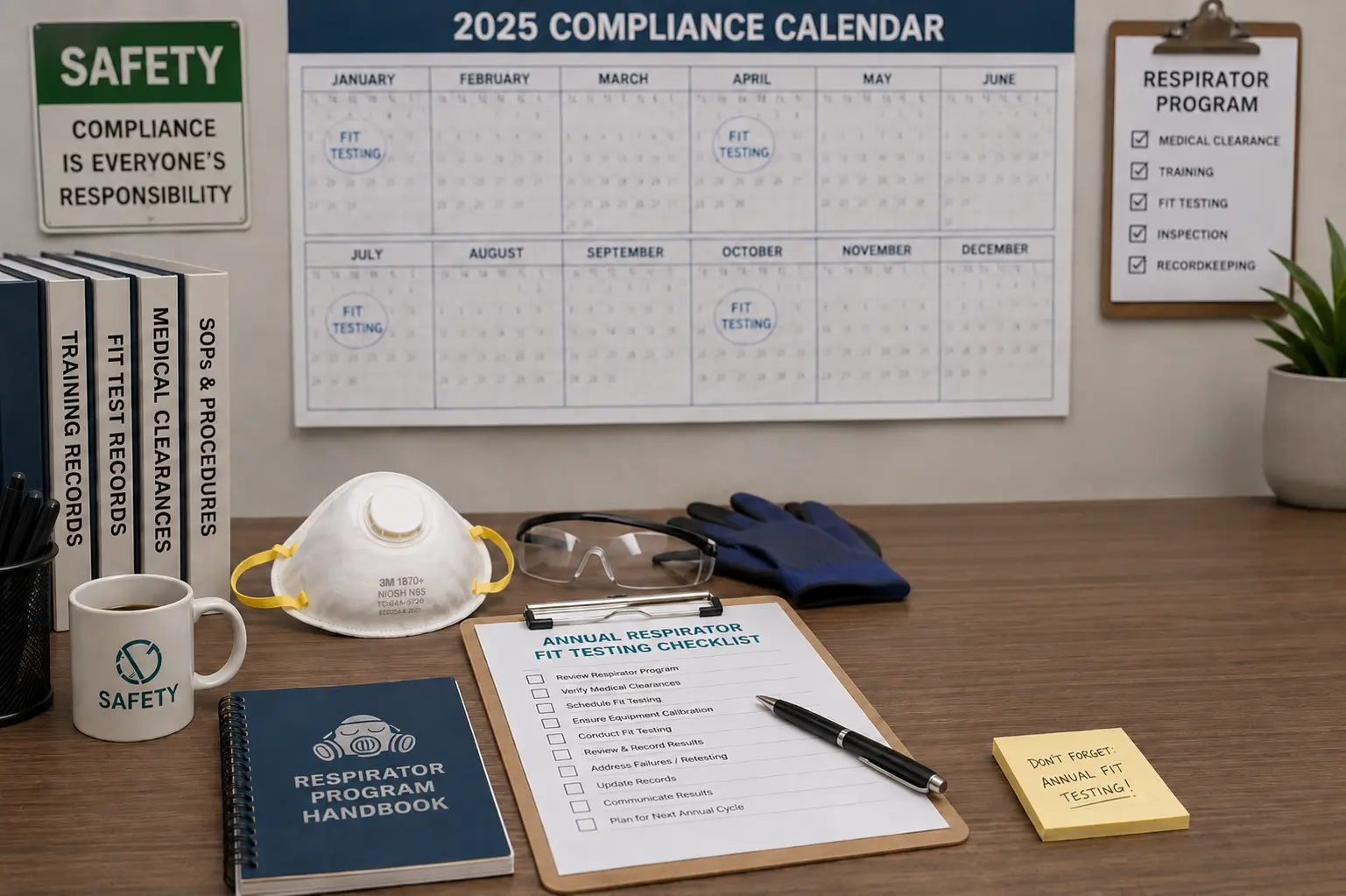
The single best upgrade to an annual program is putting the testing day on the calendar before you need it. Pick a recurring window, work the checklist above in the weeks beforehand, and you avoid the end-of-cycle rush where clearances are expiring and the schedule is jammed.
If your people are spread across more than one location, plan the round at the program level rather than site by site — the multi-site coordination guide covers how. And for the day itself, the on-site fit testing day walkthrough has the full pre-visit detail.
Frequently asked questions
How often does fit testing need to happen?
What is the most common thing employers forget each cycle?
Can we test everyone in a single annual day?
Where do the records go after the annual round?
Ready to lock in this year's testing day?
Give us your roster and respirator models and we will help you schedule a single on-site testing day for the whole crew.
Schedule an on-site testing day arrow_forward