How to Coordinate Respirator Fit Testing Across Multiple Job Sites
When your crews are spread across sites, the hard part is not the test — it is the logistics. Here is how to run fit testing as one program instead of many.
The short version
- Start from one master roster across every site, not separate lists per location.
- Group employees by location, shift, respirator type, or supervisor to plan testing days.
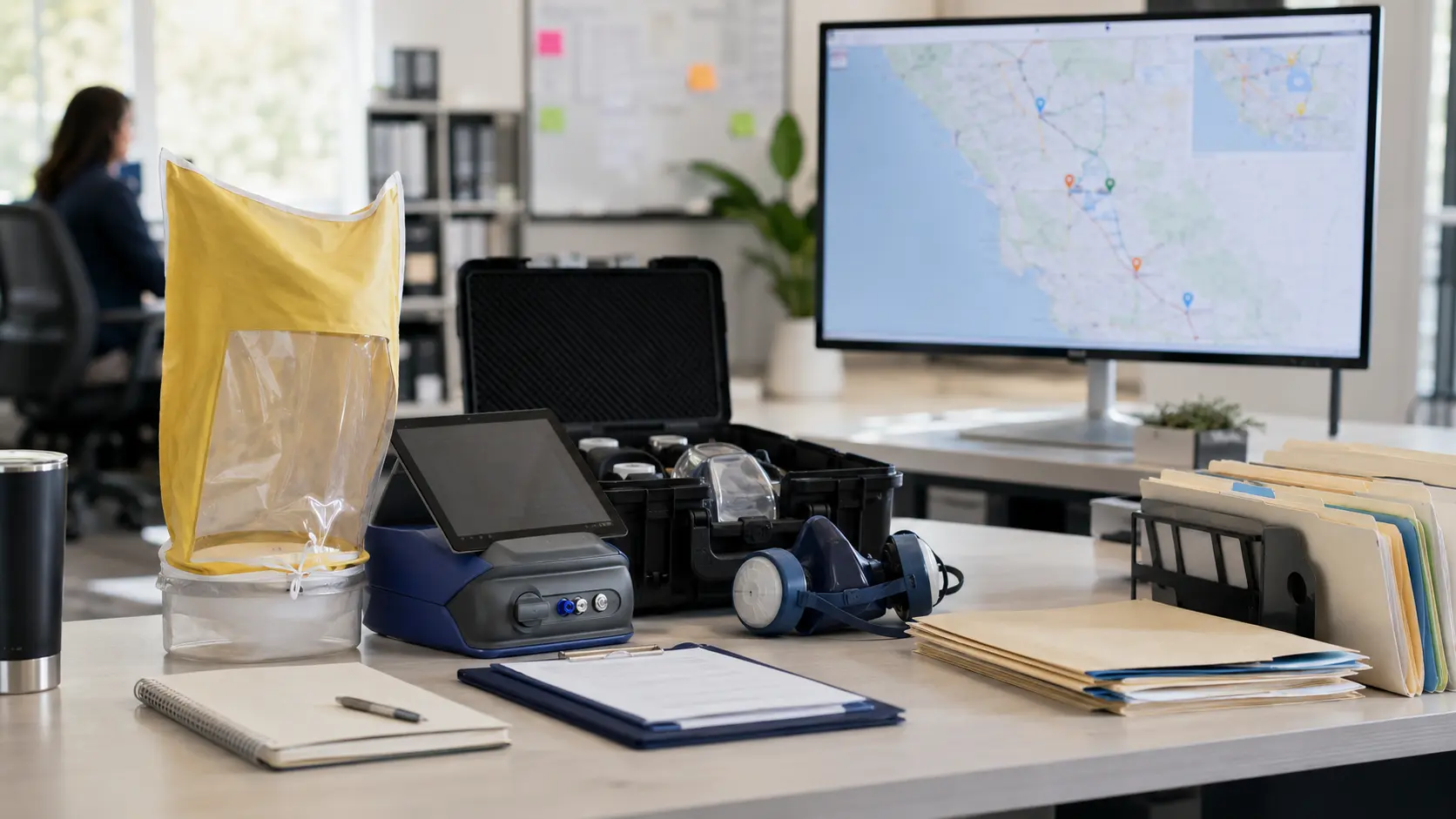
- Plan mobile testing days by route or region to cut travel and downtime.
- Coordinate clearance online for each crew and avoid duplicate documentation.
Who this is for: Construction, facilities, public-sector, logistics, industrial, and other multi-site employers.
Single-site fit testing is mostly about the day. Multi-site fit testing is about the program: pulling scattered crews into one plan, sequencing testing days that make geographic sense, and keeping the records straight when the same person might be touched by two sites.
This guide is built for employers running respirator programs across multiple locations — construction, facilities, public sector, logistics, and industrial. It is written to stay broadly useful, with notes for California and Bay Area teams where on-site routing applies.
How to coordinate testing across sites
The order matters: build the single roster first, then everything downstream gets easier.
-
Build one roster across all sites
Consolidate every employee who needs testing into a single master list with their site, shift, supervisor, and assigned respirator. This is the backbone of the whole program — separate per-site lists are where duplicates and gaps come from.
-
Group employees by the right dimension
Slice the roster by location, shift, respirator type, or supervisor depending on how you will run the days. Grouping by respirator type, for example, minimizes setup changes during testing.
-
Plan mobile testing days by route or region
Cluster nearby sites into a single testing day or a short route so the tester travels efficiently and downtime stays low across the program.
-
Coordinate the clearance workflow across sites
Clearance must come before fit testing, but QuickCare runs it online by SMS — so each site's crew can be cleared before the visit or on the day. The thing to get right across sites is accurate phone numbers on the master roster.
-
Handle contractors and temporary crews
Decide up front who is responsible for testing contractors and temps, and how their records are kept. Flag them on the roster so they are not missed or double-counted.
-
Reconcile records into one program file
Bring every site's results back into a single, de-duplicated record set so an employee touched by two sites has one current record, not two conflicting ones.
Multi-site coordination checklist
Run this before you schedule the first route.
Roster & grouping
- One master roster with site, shift, supervisor, and respirator per person
- Employees grouped by location, shift, respirator type, or supervisor
- Contractors and temporary crews flagged and assigned an owner
Logistics & records
- Testing days clustered by route or region
- Clearance coordinated per site — online links sent ahead or completed on the day
- A single program file that de-duplicates results across sites
- A point of contact named for each site
Crews spread across several sites?
Send QuickCare your sites, headcounts, and respirator models and we will help map locations, routes, and crews into one coordinated testing plan.
Multi-site mistakes to avoid
- Keeping separate rosters per site that never reconcile.
- Routing the tester inefficiently because days were not clustered by region.
- Wrong or missing phone numbers, so the online clearance links do not reach crews in the field.
- Letting contractors fall through the gap between "their" responsibility and yours.
- Ending up with duplicate or conflicting records for the same employee.
Running it as one program
The throughline is simple: one roster, one record set, routed days. Once the master roster exists, planning a route across the Bay Area or wider California becomes a scheduling exercise rather than a guessing game — clustering nearby teams such as San Jose and Oakland into efficient on-site days.
For the recurring side of this, pair it with the annual checklist; for the documentation rules that keep your single program file clean, see clearance vs. fit testing. Our on-site fit testing service is built to come to your sites.
Frequently asked questions
Should each site keep its own fit-test records?
How do we handle contractors and temporary crews?
What is the best way to group employees across sites?
Can on-site testing cover several locations in one plan?
Coordinating fit testing across multiple sites?
Share your sites, headcounts, and respirator models and we will help you plan routed on-site testing days with one clean record set.
Plan multi-site testing arrow_forward