person_add Create An Account phone Call 1-888-250-4659
lightbulb_outline

Workplace Safety Solutions

Comprehensive solutions designed for your industry's specific risks and operational needs.

new_releases New

OSHA Recordable Reduction

Proactively lower your OSHA recordable incident rate with our expert on-site response and documentation services.

Learn More arrow_forward

Solutions by Use Case / Need

Most Popular
location_on
On-Site Services

Access safety and health services directly at your worksite for ultimate convenience and efficiency.

trending_down
OSHA Recordable Reduction

Improve safety ratings and lower costs by proactively managing and reducing recordable incidents.

local_fire_department
Emergency Response

Deploy our rapid response teams for immediate medical care during workplace emergencies.

gavel
Liability Reduction

Mitigate risks with pre-employment health screenings and compliant documentation.

no_drinks
Drug-Free Workplace

Implement comprehensive substance use testing programs to maintain a safer workplace.

favorite_border
Life-Saving Training

Equip your team with CPR/AED & First-Aid training for vital emergency preparedness.

Recommended
medical_services
On-Site First Aid

Benefit from immediate first aid response available directly at your workplace.

verified_user
DOT Drug & Alcohol Testing

Meet Department of Transportation drug testing regulations efficiently and accurately.

masks
Respirator Fit Testing

Ensure respiratory protection meets safety standards with our certified testing services.

science
On-Site Drug Testing

Utilize our convenient, accurate drug screening services performed at your location.

Trending
wb_sunny
Heat Illness Prevention

Protect workers from heat stress with proactive monitoring and prevention programs.

Solutions by Industry

Top Industry
precision_manufacturing
Manufacturing

Implement comprehensive safety protocols for production facilities with our expertise.

construction
Construction

Address unique site risks with specialized safety services for the construction sector.

High Demand
warehouse
Warehouse & Distribution

Enhance safety in logistics and storage facilities with our targeted solutions.

local_shipping
Transportation

Ensure DOT compliance and operational safety in logistics and transit operations.

set_meal
Food Processing & Mfg

Ensure compliance and worker safety in food production with specialized services.

format_paint
Painting Contractors

Address specific hazards faced by painting professionals with our safety programs.

local_hospital
Healthcare

Enhance safety standards in medical and care environments with our tailored programs.

biotech
Laboratory Safety

Implement specialized protocols to manage risks in laboratory environments.

Solutions by Organization Type

Enterprise-Grade
business
Enterprise

Deploy scalable, comprehensive safety solutions across large organizations.

Growing Segment
store
Small & Medium Business

Access tailored, affordable safety solutions designed for SMB needs.

account_balance
Public Sector

Implement robust safety programs for government agencies and institutions.

rocket_launch
Startups

Build a strong safety foundation from the ground up with our flexible solutions.

price_check

Flexible Pricing

Transparent, pay-as-you-go pricing with no hidden fees. Find the right plan for your business size and needs.

travel_explore

Service Coverage Map

Visually explore our service areas, check response times, and see how we support your industry across the Bay Area.

Initializing Map...
Legend
Active Service Area
Limited Service
place
Counties Served
9
groups
Population Covered
7.6M+
av_timer
Avg. Response
54 min
Planning an On-Site Day

How Many Employees Can Be Fit Tested Per Hour?

How fast a testing day moves depends on a few variables you control. Here is how to estimate throughput and build a schedule that keeps the line moving.
6 min read Updated June 16, 2026 Reviewed by QuickCare Field Operations
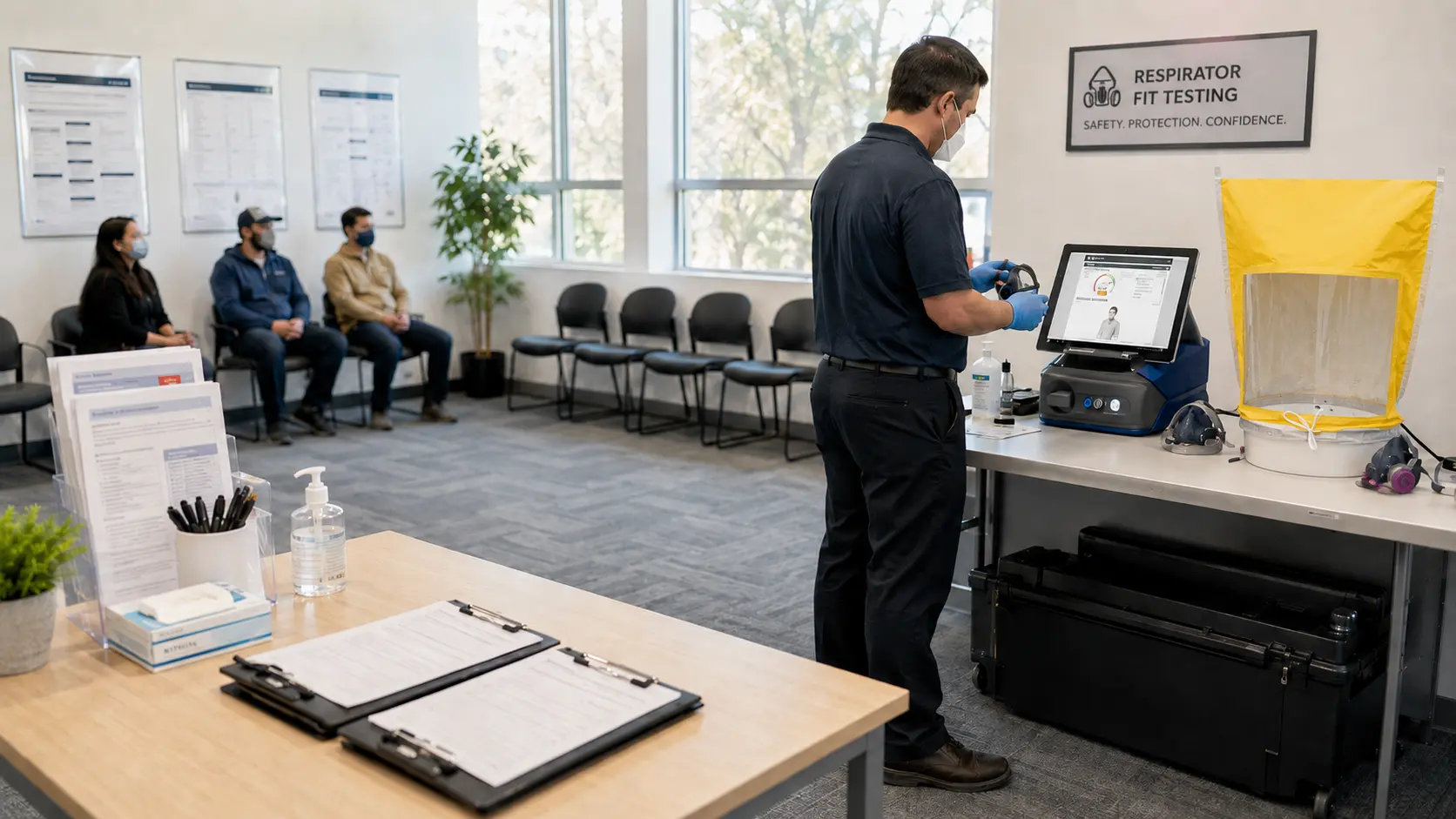
Organized employer fit testing flow for multiple employees

The short version

  • Fit testing throughput depends on the method, number of respirator models, employee readiness, room setup, and how tightly the schedule is managed.
  • Medical clearance must be completed before an employee is fit tested, but QuickCare can coordinate clearance online by SMS before or during the appointment day.
  • The biggest throughput problems usually come from unknown respirator models, poor staging, facial hair, missing employee contact information, or no retest buffer.
  • A good schedule groups employees by shift, department, respirator type, or work area so the tester is not constantly resetting the flow.

Who this is for: EHS managers and operations leads sizing an on-site fit testing day.

"How many people can you test per hour?" is the first question every EHS manager asks when sizing a fit testing day — because it determines whether one block covers the crew or whether you need a second.

There is no single number, but the variables that drive throughput are predictable. Once you know them, you can estimate your own day with confidence and schedule accordingly.

What actually drives the pace

"How many employees can be fit tested per hour?" is the right question, but the answer depends on the shape of the day.

The fastest visits are not just fast because the test itself is quick. They are fast because the employer has a clean roster, employees are nearby when called, respirators are available, and the site has a logical flow from waiting area to testing area to completion.

Medical clearance is part of that flow, but it should not be treated as a separate obstacle. With QuickCare, employees can complete clearance online through an SMS link. That can happen ahead of the appointment or on the day of service. The main planning issue is making sure the roster and phone numbers are accurate so clearance can move without slowing the testing line.

The variables to estimate against

Score your own day against each of these before you assume a single block is enough.

Throughput factors

  • Test method — qualitative and quantitative fit testing move at different paces.
  • Respirator model count — more models and sizes usually mean more setup changes.
  • Employee readiness — employees should know when to report and should have access to the respirator they will use.
  • Clearance workflow — clearance must be complete before fit testing, but QuickCare can coordinate it online by SMS before or during the visit.
  • Room setup — a nearby waiting area keeps the next employee ready.
  • Retest buffer — leave room for employees who need to shave, adjust technique, try another size, or retest.

Not sure whether your crew fits into one testing block?

QuickCare can estimate the visit structure from your headcount, shifts, respirator models, and clearance plan.

Get a visit estimate

Qualitative vs. quantitative: how they differ for planning

Qualitative Quantitative
What it measures Pass/fail based on the wearer's response A measured fit factor
Relative pace Often faster per person Typically takes longer per person
Planning impact More people per block Build in more time per employee

Turning variables into a schedule

Rather than chase a fixed per-hour number, plan in blocks. Group employees by shift and respirator type, keep a waiting area stocked with the next person, and reserve a buffer at the end of the day for retests. For a crew of around 25 with a coordinated clearance workflow and a small number of respirator models, a single well-run on-site day is commonly enough.

For the full pre-visit checklist, see how to plan an on-site fit testing day.

Throughput-killers to avoid

  • Assuming a per-hour rate without accounting for the test method.
  • Mixing many respirator models into one block.
  • No waiting area, so the tester idles between employees.
  • Missing or wrong employee phone numbers, which is what actually slows the online clearance step.
  • No buffer for retests.

Frequently asked questions

Qualitative fit testing is often faster per person, while quantitative fit testing typically takes longer because it produces a measured fit factor. Which one you need depends on the respirator and your program — both should be planned for differently.

In many cases, yes — when the clearance workflow is coordinated (online links sent ahead or completed on the day), the respirator models are limited, and employees are scheduled in tight shift-based blocks with a ready waiting area. Larger groups or many respirator models may call for a second block.

Unknown respirator models, frequent setup changes between models, poor staging with no ready waiting area, missing employee phone numbers (which slow the online clearance step), and no buffer for retests. Clearance itself rarely needs to be the bottleneck — QuickCare runs it online by SMS before or during the visit.

Not sure if one block covers your crew?

Share your headcount and respirator models and we will help you right-size the schedule.

Get a scheduling estimate