N95 Fit Testing for Healthcare Teams
For infection-control, EHS, and practice managers: when a new hire or a model change triggers an N95 fit test, QLFT versus QNFT for filtering facepieces, and how to plan rounds around shifts.
The short version
- If your workplace requires employees to wear a tight-fitting N95, each of them needs a medical evaluation and then a fit test before first use, when the N95 make, model, style, or size changes, and at least annually.
- A fit test applies only to the exact N95 that was tested. If supply forces a switch to a different model, the people who will wear it need a new test on that model.
- Qualitative (pass/fail) and quantitative (measured fit factor) testing are both options for N95s. Either way, the medical evaluation comes first, and facial hair at the seal is a problem every time the respirator is worn.
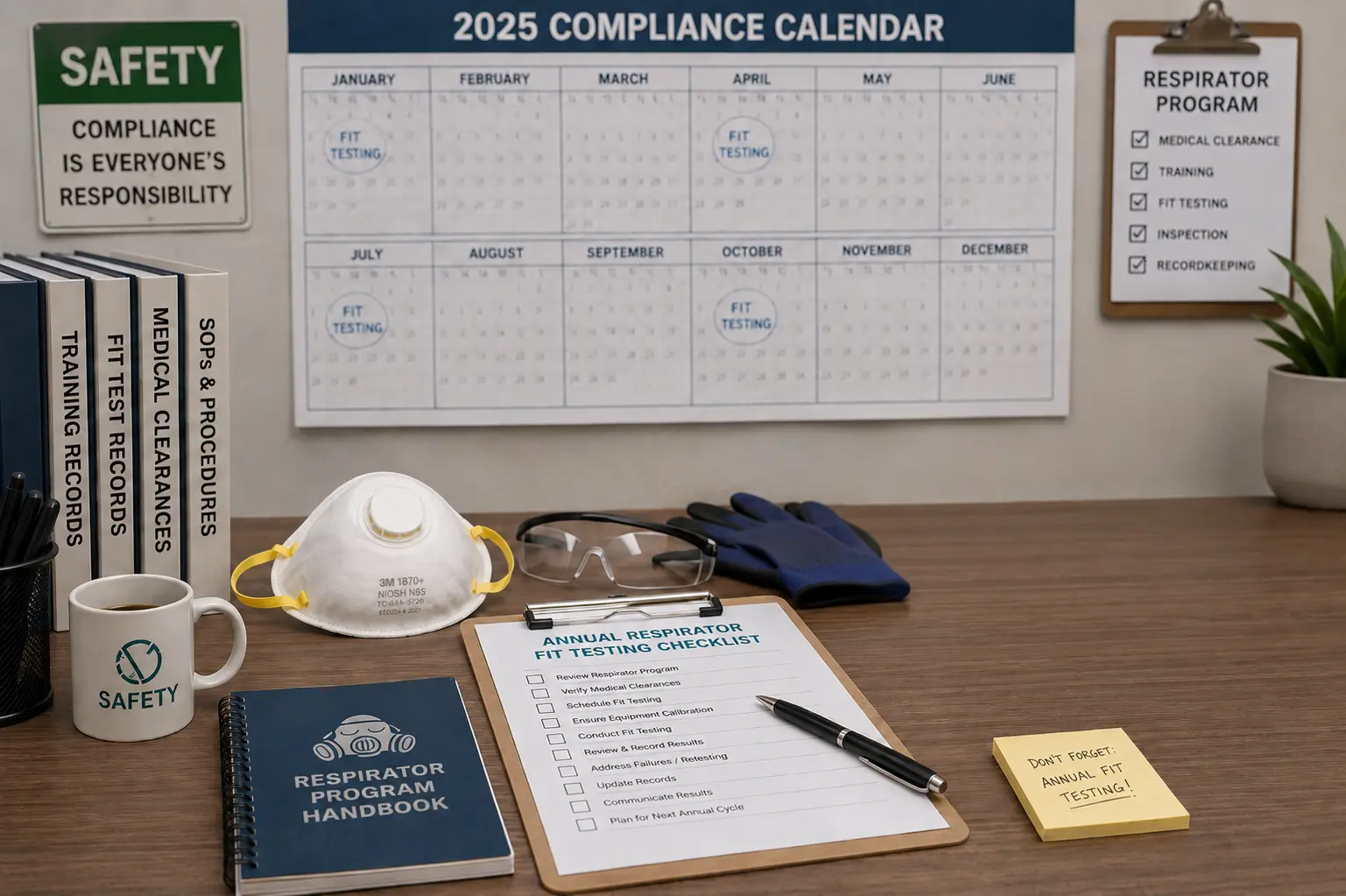
- Build new-hire testing into onboarding and the annual round into the calendar, with a block for each shift.
Who this is for: Infection-control leads, EHS and safety managers, practice managers, and HR coordinators at clinics, dental offices, and hospitals.
In a healthcare setting the N95 is not a one-time purchase. It is a respirator program: a written plan, a medical evaluation for each wearer, a fit test on the exact model, training, and records, repeated at least once a year and again whenever the model changes. Staff turnover, rotating shifts, and supply substitutions make that cycle harder to keep on track than the standard makes it sound.
This guide is for the person who has to keep that cycle moving. It covers which situations call for a test, which rules apply to a healthcare employer in California, the two test methods for filtering facepieces, and how to plan a day at a clinical site. The requirements come from federal OSHA's respiratory protection standard and from California's Cal/OSHA counterpart.
When an N95 fit test is needed
| Situation | Fit test needed? | Why |
|---|---|---|
| A new hire who must wear an N95 | Yes, before first required use | Fit testing comes before initial use of a tight-fitting respirator, after the medical evaluation |
| The same employee, the same N95 model, one year later | Yes, at least annually | The standards set an annual minimum |
| Supply switches the facility to a different N95 make, model, style, or size | Yes, on the new respirator | A fit test applies only to the facepiece that was tested |
| A physical change that could affect the seal, such as weight change, dental work, or facial scarring | Yes, an additional test | A reported change that could affect fit calls for a retest |
| An employee wears an N95 voluntarily where the employer does not require one | Not required | Voluntary-use provisions apply instead; ask your EHS lead how your policy treats it |
| An employee uses a loose-fitting hood or helmet PAPR instead | No fit test | Loose-fitting facepieces are not fit tested; the medical evaluation still applies |
Which rules apply to a healthcare employer in California
Respirator programs at California workplaces run through Cal/OSHA's Title 8 section 5144, which parallels federal OSHA's 29 CFR 1910.134. Healthcare employers may also be covered by Cal/OSHA's Aerosol Transmissible Diseases standard, section 5199. Section 5199 lists hospitals, clinics, medical offices and other outpatient facilities among the settings it covers. It calls for a respiratory protection program that meets section 5144, respirators at least as effective as an N95 where respiratory protection is needed, and fit testing at initial fitting, when the size, make, model, or style changes, and at least annually.
Whether section 5199 applies to a particular office is a scope question. Some outpatient dental and specialty practices are excluded when they meet the conditions the standard lists, and others are not. Confirm coverage for each of your sites with your infection-control lead, EHS lead, or counsel before assuming either way.
For the written program itself, QuickCare's Written Respiratory Protection Program is an online builder for that document. It summarizes the federal standard and does not cite section 5144 or section 5199, so check your program against both.
Start with the medical evaluation
No one is fit tested until the medical evaluation is done. Each employee completes the medical questionnaire (or an equivalent initial examination), a physician or other licensed healthcare professional (PLHCP) reviews it, and the employer receives the PLHCP's written recommendation, not the employee's answers. Some employees need a follow-up before they can be cleared.
QuickCare does not promise a review turnaround, so start the evaluation before the testing date, especially for a large onboarding class. ProTrain by QuickCare is a separate online service, available nationwide, that offers the N95 medical clearance evaluation online. For Bay Area employers, QuickCare's in-person Respirator Package includes the evaluation and clearance process with the on-site visit. A medical evaluation is not a fit test, and a fit test cannot be done online.
Planning N95 rounds for a clinic, dental office, or hospital?
Tell QuickCare your headcount, shifts, and the N95 models you stock, and we will follow up about scoping an on-site visit.
Qualitative or quantitative for N95s
An N95 is a negative-pressure, air-purifying filtering facepiece, so both fit-test methods can be used.
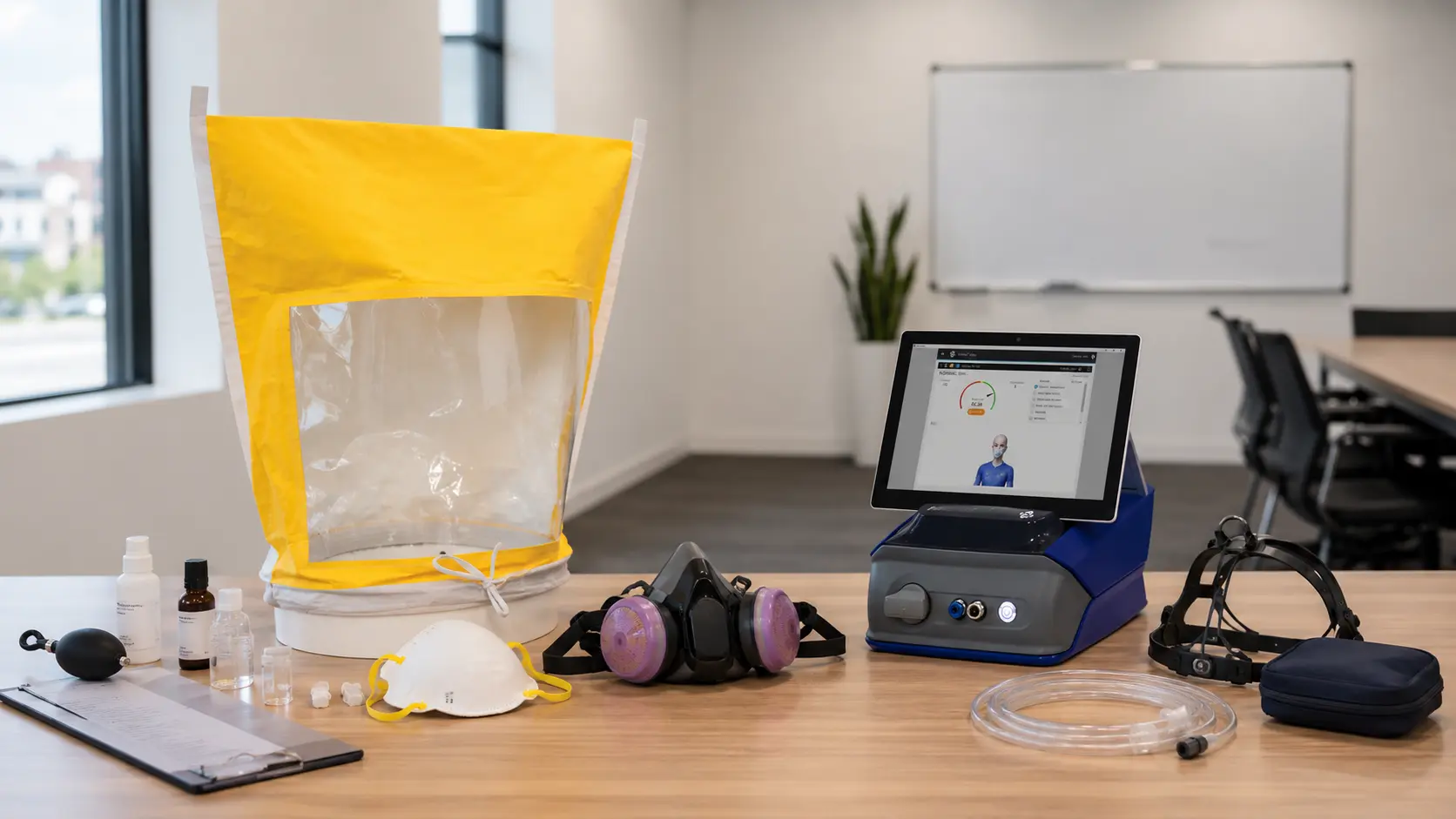
- Qualitative (QLFT) is a pass/fail test based on whether the wearer detects a test agent. For particulate filtering facepieces, the taste-based saccharin and Bitrex protocols are the usual choice. They include a taste-sensitivity screening and ask employees to avoid food, drink other than plain water, smoking, and gum for 15 minutes beforehand. QLFT does not need a measuring instrument.
- Quantitative (QNFT) uses an instrument to measure a fit factor, and for a filtering facepiece the passing fit factor is at least 100. It produces a number and a test recording, and is useful when you want measured results or when an employee cannot complete a taste test.
Which method to use is a program decision. Some programs run QLFT for routine rounds and keep QNFT for people who cannot complete a taste test. Ask your tester which protocols they run for filtering facepieces. The qualitative vs. quantitative guide has the full comparison.
New hires versus annual rounds
The two run on different clocks. Plan both.
New-hire testing
- Add the medical evaluation and the fit test to onboarding, ahead of the first shift that requires an N95
- Record the N95 make, model, style, and size the person is issued, and test on that exact respirator
- Give the new hire a short briefing: clean-shaven at the seal, how to put the respirator on, and how to do a user seal check each time
- Batch new hires into a standing catch-up window so no one waits for the next annual day
Annual rounds
- Pull a current roster with each person's last test date and the N95 model they were tested on
- Flag anyone whose assigned model changed since their last test
- Schedule a block for each shift, including nights and weekends, rather than asking those staff to come in on days
- Reserve a retest buffer and a plan for staff who miss their slot
When the N95 model changes
Healthcare supply chains change. If purchasing switches to a different make, model, style, or size, everyone who will wear it needs a fit test on that respirator before they rely on it. A pass on the old model says nothing about the new one.
- Keep a short approved list instead of a single model. N95s come in different shapes and sizes, and a person who cannot seal one may seal another.
- Record the model on every roster line and update it when purchasing changes, so the next round tests people on what they actually wear.
- If staff rotate between models, test each person on every model they might be issued.
- Settle your substitution plan with your EHS and infection-control leads before a shortage, not during one.
Beards, stubble, and PAPR alternatives
Facial hair that comes between the sealing surface and the face stops an N95 from sealing, and it is not permitted with a tight-fitting respirator at any time it is worn. For staff who cannot be clean-shaven, a loose-fitting hood or helmet powered air-purifying respirator is not fit tested and can be an alternative where it suits the hazard and your program. The medical evaluation still applies. Settle this conversation before test day, not at the door of the testing room.
Planning an on-site day at a clinical site
A clinical site adds constraints a warehouse does not: patient areas, coverage, and infection control.
Room and flow
- Choose a quiet room away from patient-care and waiting areas, with a table, chairs, and access to power
- Stage staff by unit or shift so coverage on the floor stays safe while people step away
- Ask the tester how test equipment and any shared sizing samples are cleaned between employees
- Name one day-of contact who can release the next person and answer questions
People and paperwork
- A roster with unit, shift, N95 make, model, and size, last test date, and medical-evaluation status
- A rule that staff with an open evaluation are not tested, with their slot held for a later window
- A retest buffer, and a plan for staff on leave or off-site
- A named person who files each result in the respirator program records after the visit
Where healthcare programs trip up
- Testing staff before their medical evaluation is finished.
- Assuming a test on one N95 model carries over to another.
- Letting new hires start N95 work and waiting for the next annual round to test them.
- Leaving night, weekend, and per-diem staff out of the annual schedule.
- Treating a beard as a scheduling problem on test day instead of a program decision made earlier.
- Keeping fit-test results somewhere the next person to run the program cannot find them.
Records to keep
For each person, keep the name or identifier, the type of test, the N95 make, model, style, and size tested, the date, and the result (for a quantitative test, the fit factor and the test recording). The employer keeps fit-test records until the next fit test, and medical-evaluation records follow the separate access-to-records rules. The records guide covers the details, and the requirements reference explains the standards in plain language.
A note on scope
This guide is planning information, not legal or clinical advice, and following it does not guarantee any OSHA or Cal/OSHA inspection outcome. QuickCare supports your respiratory-protection documentation. Confirm which standards apply to each of your sites with your EHS and infection-control leads.
Frequently asked questions
Do all healthcare workers need an N95 fit test?
How often does an N95 fit test need to be repeated?
Does a new N95 model need a new fit test?
Is a qualitative or quantitative test better for N95s?
What about staff with beards?
Do we need a medical evaluation before the fit test?
Planning N95 fit testing for your clinic, dental office, or hospital?
Tell QuickCare your headcount, shifts, and the N95 models you stock and we will follow up about scoping an on-site visit.
Get an N95 fit-testing quote arrow_forward