
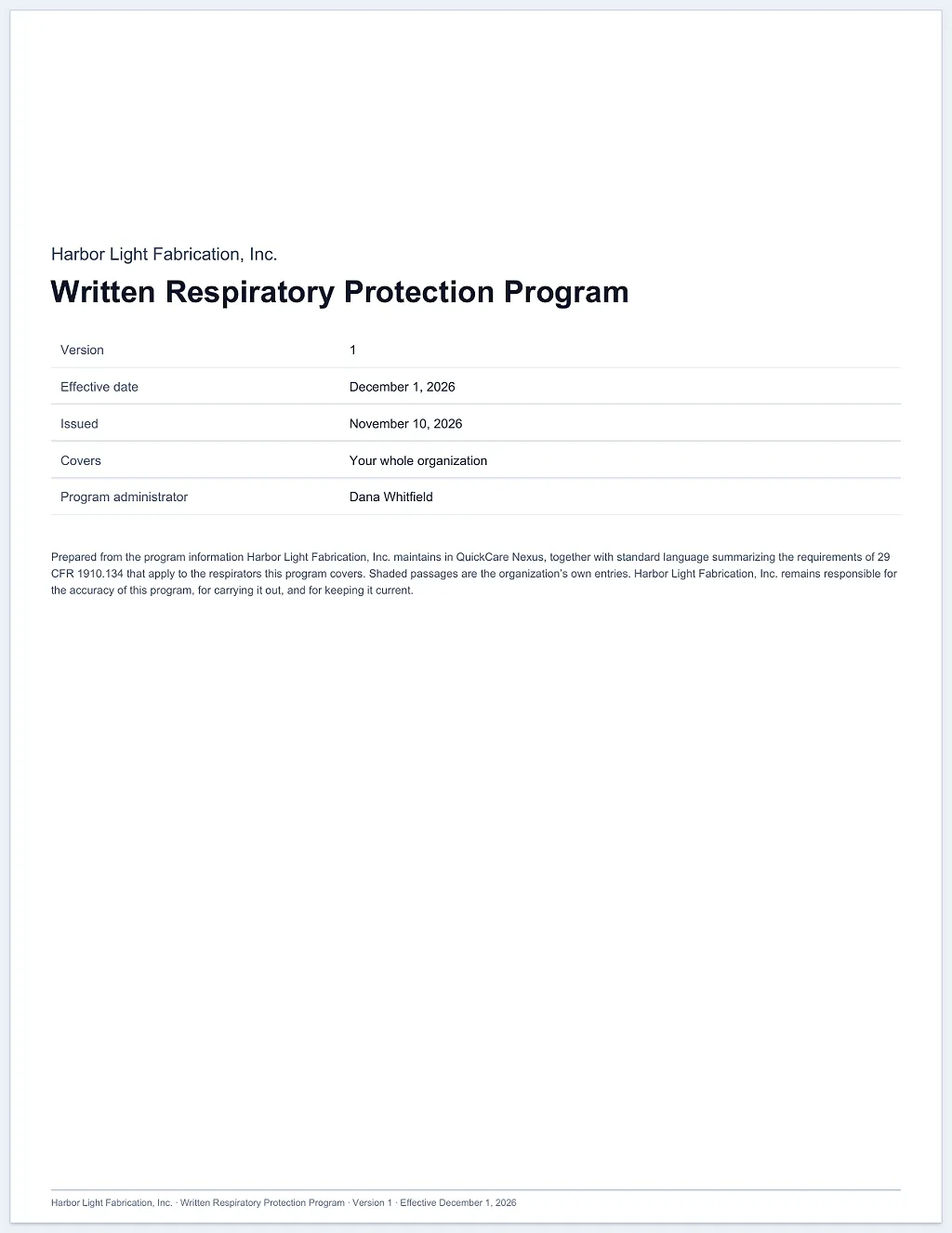
Harbor Light Fabrication, Inc.
Written Respiratory Protection Program
1. Purpose and scope
Harbor Light Fabrication, Inc. has established this written respiratory protection program to protect employees from respiratory hazards in the workplace, under the OSHA respiratory protection standard, 29 CFR 1910.134. It applies to the work sites and operations described below and is updated when workplace conditions that affect respirator use change. [(c)(1)]
This program covers every employee of Harbor Light Fabrication, Inc. who uses a respirator, at every work location.
Operations and tasks covered
Welding bays, the grinding and finishing cell, parts-cleaning stations, and the paint-prep booth. Respirators are used during stainless steel welding, grinding, and any solvent cleaning or priming.
Respiratory hazards
Welding fume and metal dust from stainless and carbon steel fabrication, grinding and sanding dust, and solvent vapors from parts cleaning and the paint-prep booth.
Respirators that employees are required to wear, and the training and medical evaluations this program requires, are provided at no cost to employees. [(c)(4)]
visibility What to notice
Shaded boxes are this employer's own entries. Everything else is standard language that summarizes 29 CFR 1910.134, with a bracketed paragraph reference such as [(c)(1)].
2. Program administrator
- Name
- Dana Whitfield
- [email protected]
The program administrator oversees this program, keeps it current, evaluates its effectiveness, and keeps its records. The program administrator must have the training or experience needed to administer the program and to conduct the required evaluations of its effectiveness. [(c)(3)]
3. Respirators and their use
This program covers the following respirators:
- N95 / filtering facepiece — voluntary use
- Half-face elastomeric — required use
- PAPR, loose-fitting hood/helmet — required use
Respirators are selected on the basis of the respiratory hazards employees are exposed to and the workplace and user factors that affect how a respirator performs. Only respirators certified by the National Institute for Occupational Safety and Health (NIOSH) are used, in keeping with the conditions of their certification, and a sufficient number of models and sizes is provided so that each respirator is acceptable to and fits its user. [(d)(1)]
Selection details
Half-face elastomeric respirators with particulate and organic-vapor cartridges for grinding and solvent work; loose-fitting powered air-purifying respirators under welding helmets; N95 filtering facepieces offered voluntarily for light dust in the shipping area.
visibility What to notice
A section appears only when it applies to the respirators the employer chose. This sample has no breathing-air section because it covers no supplied-air respirator or SCBA.
4. Medical evaluation
Before an employee is fit tested or required to use a respirator in the workplace, the employee receives a medical evaluation by a physician or other licensed health care professional (PLHCP) to determine whether the employee can use the respirator. [(e)(1)]
Who performs medical evaluations
Medical evaluations are provided by QuickCare Solutions.
How evaluations are arranged
Our safety coordinator orders each employee's medical evaluation in the QuickCare account before the employee is first assigned to respirator use, and again when a medical change is reported.
Medical questionnaires and examinations are confidential, are administered during normal working hours or at a time and place convenient to the employee, and are explained so the employee understands them. The employee has an opportunity to discuss the questionnaire and examination results with the PLHCP. [(e)(4)]
The organization obtains the PLHCP’s written recommendation on whether the employee can use the respirator, any limitations on its use, and the need for any follow-up medical evaluations, and the employee receives a copy. Each employee’s follow-up and re-evaluation timing comes from that recommendation; this program does not set a routine re-evaluation cycle. [(e)(6)]
An additional medical evaluation is provided, at a minimum, when:
- the employee reports medical signs or symptoms related to the ability to use a respirator;
- a PLHCP, a supervisor or the program administrator informs the organization that the employee needs to be reevaluated;
- information from this program, including observations made during fit testing and program evaluation, indicates a need for reevaluation; or
- a change in workplace conditions (such as physical work effort, protective clothing or temperature) may substantially increase the physiological burden on the employee. [(e)(7)]
5. Fit testing
Employees who use a tight-fitting facepiece respirator (Half-face elastomeric) pass a qualitative or quantitative fit test, performed with an OSHA-accepted protocol (Appendix A to 29 CFR 1910.134), with the same make, model, style and size of respirator they will use. [(f)(1), (f)(5)]
- Methods used
- Qualitative fit testing (QLFT); Quantitative fit testing (QNFT)
- Routine fit testing
- At least every 12 months
Each of these employees is fit tested:
- before first using the respirator;
- whenever a different respirator facepiece (size, style, model or make) is used;
- at least every 12 months after that;
- again when the employee reports, or the organization, PLHCP, supervisor or program administrator observes, changes in the employee’s physical condition that could affect fit, such as facial scarring, dental changes, cosmetic surgery or an obvious change in body weight; and
- again after the employee reports that the fit is unacceptable, once the employee has had a reasonable opportunity to select a different facepiece. [(f)(2)–(f)(4)]
Qualitative fit testing is used only for negative-pressure air-purifying respirators that must achieve a fit factor of 100 or less. [(f)(6)]
A quantitative fit test is passed with a fit factor of at least 100 for a tight-fitting half facepiece and at least 500 for a tight-fitting full facepiece. [(f)(7)]
Loose-fitting PAPR hoods and helmets do not have a facepiece seal and are not fit tested.
How fit testing is arranged
Fit tests are scheduled by the safety coordinator before first use, every 12 months, and when the respirator model or the employee's facial characteristics change; results are kept in each employee's record.
visibility What to notice
The document says what does not apply, too: loose-fitting PAPR hoods and helmets have no facepiece seal, so they are not fit tested.
6. Respirator use
When and how respirators are worn
Employees put on and seal-check their respirators before entering a welding bay, the grinding cell, or the paint-prep booth, and keep them on until they leave the area. Facial hair that interferes with the seal is not permitted when a tight-fitting respirator is required.
Facepiece seal protection for tight-fitting respirators:
- Employees do not wear a tight-fitting respirator when facial hair comes between the sealing surface of the facepiece and the face or interferes with valve function, or when any other condition interferes with the face-to-facepiece seal or valve function.
- Corrective glasses, goggles and other protective equipment are worn so that they do not interfere with the seal.
- Employees perform a user seal check each time they put on a tight-fitting respirator, using the procedures in Appendix B-1 or the manufacturer’s equally effective procedures. [(g)(1)]
Work-area conditions and the degree of employee exposure are monitored. Employees leave the area where respirators are used to wash their faces and facepieces as needed to prevent skin irritation, if they detect vapor or gas breakthrough, a change in breathing resistance or facepiece leakage, and to replace the respirator or its filter, cartridge or canister elements. [(g)(2)]
Emergency use
If an alarm sounds or a respirator fails, the employee leaves the area immediately, tells the shift supervisor, and replaces or repairs the respirator before returning. No one re-enters an area with a suspected release.
7. Cleaning, storage, inspection and repair
Respirators issued for one employee’s exclusive use are cleaned and disinfected as often as necessary to keep them sanitary; shared respirators are cleaned and disinfected before being worn by a different person; and emergency-use respirators and respirators used in fit testing and training are cleaned and disinfected after each use. [(h)(1)]
Cleaning and disinfecting
Each employee cleans and disinfects their own reusable respirator at the end of every shift at the wash station in the tool crib; the safety coordinator cleans shared units between users.
Respirators are stored to protect them from damage, contamination, dust, sunlight, extreme temperatures, excessive moisture and damaging chemicals, and are packed so that the facepiece and exhalation valve are not deformed. [(h)(2)]
Storage
Respirators are stored in sealed bags in the labeled cabinets at each station, away from dust, sunlight, heat and chemicals.
Respirators are inspected before each use and during cleaning, including their function, the tightness of connections, and the condition of the facepiece, head straps, valves, connecting tube and cartridges, canisters or filters, and elastomeric parts are checked for pliability and signs of deterioration. [(h)(3)]
Inspection
Employees inspect straps, valves, facepieces and cartridges before each use; the safety coordinator inspects every respirator monthly and records the result.
A respirator that fails an inspection or is otherwise found defective is removed from service and discarded, or repaired or adjusted only by persons trained to do so, using NIOSH-approved parts designed for that respirator. [(h)(4)]
Repair, replacement and discarding
Damaged respirators are removed from service and returned to the safety coordinator, who repairs them with the manufacturer's parts or replaces them. Cartridges are changed on a set schedule and whenever breathing becomes difficult or a vapor can be smelled.
8. Training
Before employees are required to wear a respirator, and at least annually after that, they are trained so that they can demonstrate knowledge of:
- why the respirator is necessary, and how improper fit, use or maintenance can compromise its protection;
- the limitations and capabilities of the respirator;
- how to use the respirator effectively in emergencies, including when it malfunctions;
- how to inspect, put on and remove, and use the respirator, and how to check its seals;
- the procedures for maintaining and storing the respirator;
- how to recognize medical signs and symptoms that may limit or prevent its effective use; and
- the general requirements of 29 CFR 1910.134. [(k)(1)]
Training also covers the respiratory hazards employees are exposed to. Retraining is provided when changes in the workplace or in the type of respirator make earlier training obsolete, when an employee’s knowledge or use of the respirator shows that understanding or skill was not retained, and whenever else retraining appears necessary. [(k)(5)]
How training is given
ProTrain online courses (QuickCare Solutions); Training given by our organization.
ProTrain courses that match these respirators:
- Core Requirements
- Half-Face Elastomeric
- PAPR (Loose-Fitting)
- Voluntary Use / Appendix D
Employees who wear a respirator voluntarily receive the information in Appendix D to 29 CFR 1910.134, “Information for Employees Using Respirators When Not Required Under the Standard.” [(k)(6)]
Training details
New employees complete the ProTrain online course before first use; the safety coordinator gives hands-on instruction for donning, seal checks and cartridge changes.
9. Voluntary respirator use
Employees may wear a respirator voluntarily where that use does not in itself create a hazard. [(c)(2)(i)]
An employee who voluntarily wears a respirator other than a filtering facepiece is medically evaluated, and the respirator is cleaned, stored and maintained as this program describes, so that its use does not create a health hazard. [(c)(2)(ii)]
10. Program evaluation
Workplace evaluations are conducted as necessary to make sure this written program is being carried out effectively, and employees who wear respirators are regularly consulted about how well it works — including respirator fit, selection, use and maintenance — so that problems are found and corrected. [(l)]
How the program is evaluated
The safety coordinator walks each work area every quarter, talks with employees who wear respirators about fit, comfort and use problems, and updates the program after any change in process, equipment or exposure.
- Scheduled program review
- Every 12 months (our own schedule)
visibility What to notice
The twelve-month review is this employer's own schedule. The standard calls for evaluations "as necessary" and regular consultation with employees; it sets no fixed interval for reviewing a program.
11. Records
Medical evaluation records are kept as 29 CFR 1910.1020 requires. Each employee’s fit-test record is kept until the next fit test. A copy of the current written program is kept and made available on request to affected employees and to OSHA. [(m)]
12. Additional notes
Notes
This program applies to all employees of Harbor Light Fabrication, Inc. who use a respirator at work.
13. Adoption and effective date
Harbor Light Fabrication, Inc. adopts this written respiratory protection program, effective December 1, 2026. It remains in effect until it is replaced by a later version.
Program administrator (Dana Whitfield)
Date
visibility What to notice
The signature and date lines are blank: your organization adopts the program by signing it, and QuickCare does not sign it. The issued PDF then ends with a document history that lists this version and every earlier issued version.